Best AI App Builders for Non-Coders (2026): No-Code Tools Compared
A research comparison of AI app builders for people who do not code: Base44, Bubble, Duda, Glide, Adalo and FlutterFlow, with pricing from each vendor page checked 12 Nov 2026.
Affiliate disclosure: Some links on this page are affiliate links. Top10AI may earn a commission if you buy through them, at no extra cost to you. Only the Base44, Bubble and Duda links are affiliate links; Glide, Adalo, FlutterFlow and Alibaba Cloud are plain links. See how we rate for the editorial policy.
An AI app builder lets someone who does not write code describe an app (a booking tool, a client portal, a stock tracker for a small team) and get something with screens, a database, user log-ins and logic behind it. This guide is for that person: a founder, operator or team lead who needs a working app, not a marketing website and not a developer tool.
This is a research comparison, checked 12 Nov 2026. Every price and plan detail comes from the vendor’s own pricing page on that date. Top10AI did not build production apps in these tools for this article and does not award Tested or Verified badges or star ratings here. Prices change, so confirm on the vendor’s page before you pay.
- Describe an app in plain language and get the backend included: Base44. Its pricing page lists a Free plan and paid plans from $16/month billed annually (12 Nov 2026).
- A visual no-code editor for a production web or mobile app: Bubble. Web-only Starter is $32/month billed annually or $39/month billed monthly, per Bubble’s plans documentation (12 Nov 2026).
- You build sites and web apps for clients: Duda, whose Duda Vibe tool generates sites and full-stack web apps inside an agency platform. Basic is $19/month billed annually or $25/month billed monthly (12 Nov 2026).
- Internal tools from a spreadsheet or a prompt: Glide (GlideOS).
- A native iOS and Android app in the stores: Adalo, or Bubble’s mobile plans.
- You expect to hand the project to a developer later: FlutterFlow, a visual builder with code download and GitHub push.
Try Base44 → (affiliate link)
Try Bubble → (affiliate link)
Try Duda → (affiliate link)
What an AI app builder is (and how it differs from a website builder)
A website builder makes pages people read: a homepage, services, a blog, a contact form. An app builder makes software people use: they sign in, create records, change them, and see data that belongs to them. Under the hood, that means three things a website builder usually does not give you on its own:
- A database. Customers, orders, bookings, tasks: structured records your app reads and writes.
- Users and permissions. Log-ins, roles, and rules about who can see or edit what.
- Logic. Workflows like “when a booking is confirmed, email the client and block the slot”.
The “AI” part is how you get there. Some tools, such as Base44, start from a written prompt and generate the app. Others, such as Bubble and Adalo, keep a visual editor at the centre and add AI help on top. Base44’s own pricing FAQ describes the prompt-first approach: you describe what you need and it builds the “frontend, backend, database, user auth, payments” (Base44 pricing page, 12 Nov 2026).
If what you need is mostly pages and a contact form, you probably want a website builder instead. Start with the best AI website builders guide. If you want to compare prompt-to-code tools that generate and edit code for you (Lovable, Replit, Bolt), see best vibe coding tools. The term “vibe coding” comes from Andrej Karpathy’s 2 Feb 2025 post, and the debate about how far it can go is still running.
Why this is in the news this week
On 11 Nov 2026 Alibaba opened a preview of Qwen4-Max. Alibaba Cloud’s model page (last updated 11 Nov 2026) describes it as a flagship multimodal model “designed for coding, office productivity, frontend design, and complex agentic tasks”. The same page says the preview is available through Token Plan only and runs from 11 Nov to 25 Nov 2026 (UTC+8). None of the builders on this page say they use it. It is a sign of where the underlying models are heading, not a feature you can pick in these tools today.
The best AI app builders for non-coders
The order below follows the kind of project each tool is built for, from “describe it and go” to “build it visually and hand it to a developer later”. It is not a score.
1. Base44: describe the app, get the backend with it
Base44 is a prompt-first builder. Its pricing FAQ calls it a “no-code AI platform” that builds “fully-functional apps and websites”, with the backend, database, user authentication and payments included, and says apps run on “real production infrastructure”. Every plan lists an integrated backend and database, authentication and user management, analytics and multi-user editing (Base44 pricing page, 12 Nov 2026).
- Good fit: internal tools, customer portals and MVPs where you would rather describe the app than lay out every screen.
- Ownership: the FAQ says you own your code and data and can export the full source to your own GitHub repo with two-way sync. GitHub integration is listed on Builder and higher plan cards.
- Watch: usage is metered in message credits and integration credits, so heavy iteration uses up a plan faster.
For a two-way decision against Lovable, see Base44 vs Lovable.
2. Bubble: the visual no-code editor for production apps
Bubble is a visual builder: you lay out pages, define the database and wire up workflows yourself, with AI help along the way. Its plans documentation prices each app separately, with web-only, mobile-only and web + mobile plans. A mobile plan is needed to deploy a live mobile app or publish to the Apple App Store and Google Play; building and testing a mobile app does not need one (Bubble pricing and plans docs, 12 Nov 2026).
- Good fit: marketplaces, SaaS-style products and multi-user apps that need fine control over data and logic.
- Trial: the docs describe a 14-day free trial of the Starter plan for new apps.
- Watch: plans are per app, so three apps means three subscriptions.
3. Duda: client sites and web apps for agencies
Duda is built for professionals and agencies who deliver work to clients. Alongside its website builder, the Duda homepage describes Duda Vibe as a vibe coding tool that can “generate complex sites and full-stack web apps”. Every paid plan on the pricing page includes 150 monthly AI credits and a 14-day free trial (Duda pricing page, 12 Nov 2026).
- Good fit: agencies and freelancers who need client access, team seats and white-label options as well as the app itself.
- Watch: Duda prices per account with included projects; extra published Duda Vibe projects are priced separately on the pricing page.
4. Glide (GlideOS): internal business apps from a spreadsheet or prompt
Glide‘s pricing FAQ describes GlideOS as “an AI software development platform for building internal business apps from a spreadsheet, a prompt, or a file”. It also says GlideOS is a standalone product with its own subscription, separate from Glide Classic, and that you do not need a spreadsheet to start (Glide pricing page, 12 Nov 2026).
- Good fit: operations teams replacing spreadsheets and ad-hoc workflows with apps for staff.
- Watch: plans are credit-based, and the FAQ says annual plans are “coming soon”.
5. Adalo: native iOS and Android apps
Adalo describes itself as “the visual AI app builder for database-driven web apps and native iOS and Android apps”. Its pricing page says the Free plan is for building and testing, and publishing to the Apple App Store and Google Play starts on the paid Builder plan (Adalo pricing page, 12 Nov 2026).
- Good fit: a consumer or member app that has to live in the app stores.
- Watch: the Free plan caps each app at 500 records, and the number of published apps is fixed per plan.
6. FlutterFlow: visual building with a developer exit
FlutterFlow says its visual builder is now called FlutterFlow Studio, and one subscription covers both. Its plan comparison lists custom code, pushing project code to GitHub and downloading project source code (FlutterFlow pricing page, 12 Nov 2026). It asks more of you than the tools above, but it suits a project you expect a developer to take over.
- Good fit: founders who want a polished mobile or web app now and a clean hand-off later.
- Watch: it is low-code, not no-code. Expect to learn more concepts than in Base44 or Glide.
Already on Lovable and weighing a move? See Lovable alternatives.
Pricing at a glance (vendor pricing pages, checked 12 Nov 2026)
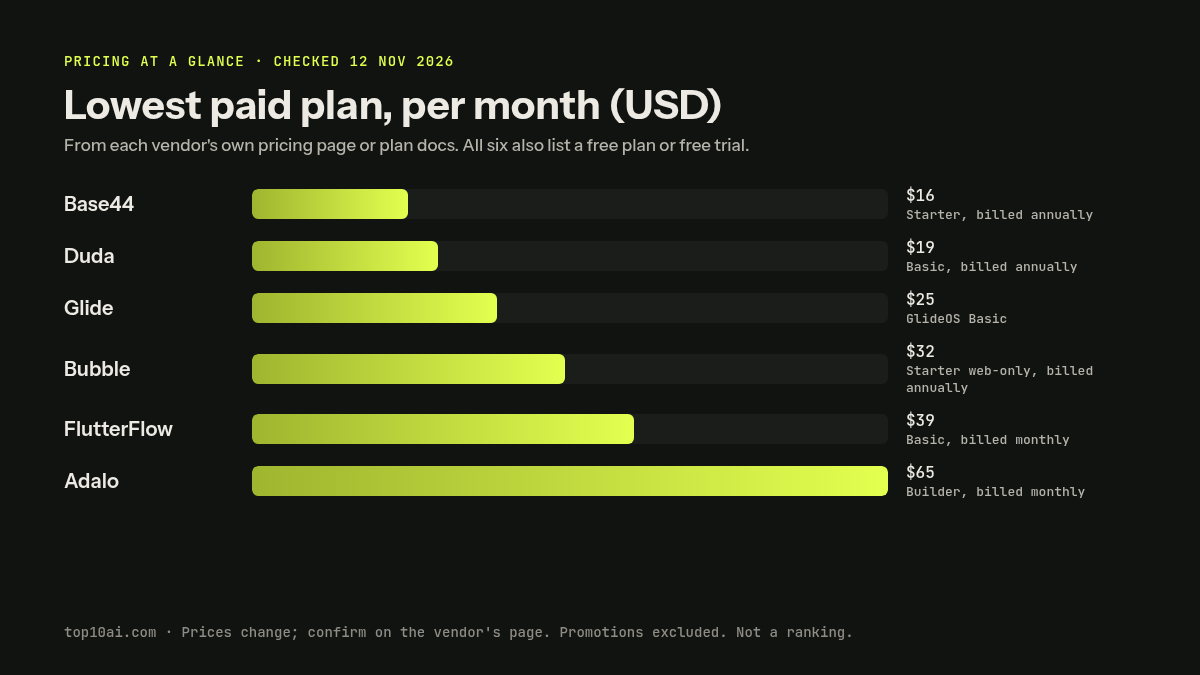
All prices are in US dollars per month unless stated, as each vendor’s own pricing page or plan documentation showed them on 12 Nov 2026. “Billed annually” means the monthly equivalent of a yearly charge. Adalo’s page labels some prices as regional, so you may see different figures where you are.
| Builder | Free plan | Entry paid plan | Higher plans | Source (12 Nov 2026) |
|---|---|---|---|---|
| Base44 | $0: 25 message credits and 100 integration credits a month, up to 5 apps | Starter $16/mo billed annually | Builder $40, Pro $80, Elite $160 (/mo, billed annually); FAQ says yearly billing saves 20% | base44.com/pricing |
| Bubble | Free plan for building; mobile apps can be built and tested free | Starter (web only) $32/mo billed annually or $39/mo monthly | Growth $119 / $134; Team $349 / $399 (web only, annual / monthly); Starter web + mobile $59 / $69 | Bubble plans docs |
| Duda | 14-day free trial (no free plan listed) | Basic $19/mo billed annually or $25/mo monthly | Team $29 / $39; Agency $52 / $69; White Label $149 / $199 (annual / monthly) | duda.co/pricing |
| Glide (GlideOS) | $0 with limited credits | Basic $25/mo | Plus $50/mo; Pro $125/mo | glideapps.com/pricing |
| Adalo | $0 for building and testing; 500 records per app | Builder $65/mo monthly, or $624 billed yearly | Business $200/mo monthly, or $1,920 billed yearly | adalo.com/pricing |
| FlutterFlow | $0 with a free AI allowance | Basic $39/mo monthly, or $351 billed yearly | Pro $80/mo or $720/yr; Max $150/mo or $1,350/yr | flutterflow.io/pricing |
Time-limited promotions shown on some pages on 12 Nov 2026 (a Base44 sale banner and an Adalo first-month offer) are left out because they expire.
Which builder fits which project
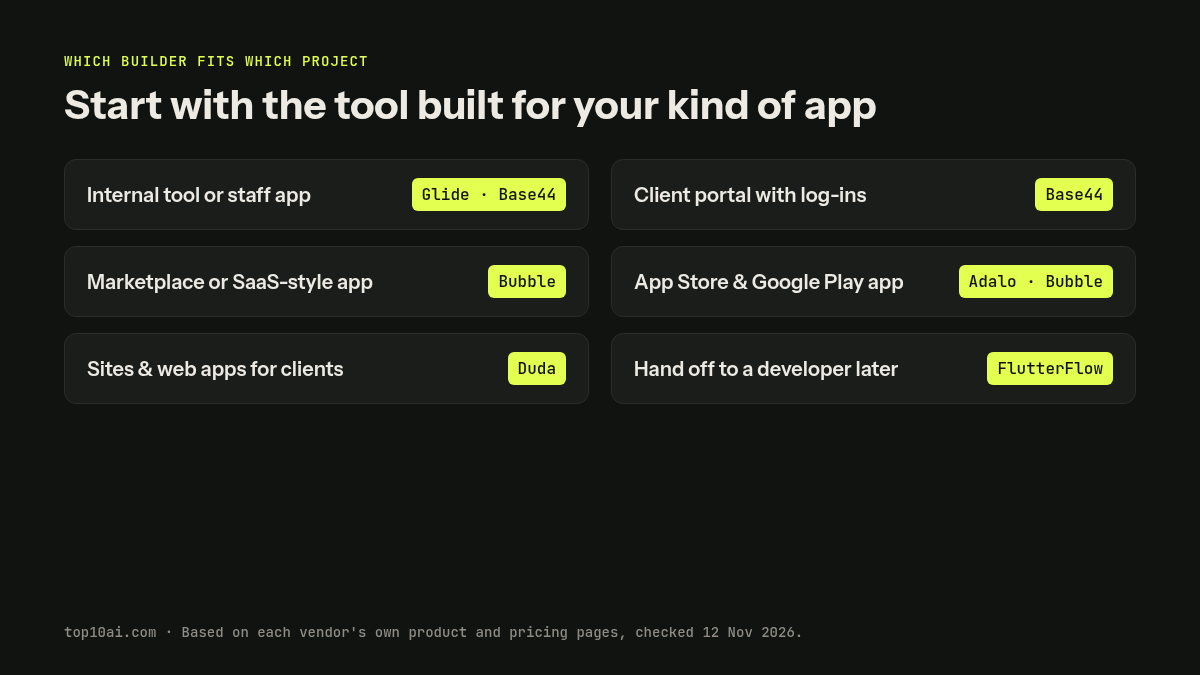
| Your project | Start with | Why (from the vendor’s own pages) |
|---|---|---|
| Internal tool or staff app | Glide or Base44 | GlideOS is pitched at internal business apps; Base44 includes auth and a database on every plan. |
| Customer or client portal with log-ins | Base44 | Authentication, user management and a backend are listed on every plan. |
| Marketplace or SaaS-style product | Bubble | Visual control over the database and workflows, with web and mobile plans. |
| App in the App Store and Google Play | Adalo or Bubble (mobile plan) | Both document publishing to the Apple App Store and Google Play on paid plans. |
| Sites and web apps you build for clients | Duda | Agency workspace, client access and Duda Vibe for web apps. |
| Prototype you will hand to a developer | FlutterFlow | Code download and GitHub push are listed on its plans. |
Limits, and when you still need a developer
These tools remove a lot of work, but not all of it. Plan for help in these cases:
- Regulated data. Health, payment-card or other sensitive data brings legal duties that a builder’s default settings do not cover. Check each vendor’s security and compliance pages, and get someone who knows the rules.
- Complex integrations. Connecting to an old internal system or an unusual API often needs custom code. FlutterFlow and Base44 both mention code editing or custom code; plain no-code tools may not reach that far.
- Usage-based bills. Base44, Glide, Duda and FlutterFlow all meter AI use in credits or allowances. Base44’s FAQ adds that third-party services you connect, such as Stripe or OpenAI, bill you directly.
- Lock-in. Check before you build whether you can take your code or data with you. Base44 (GitHub sync) and FlutterFlow (code download) document an export path. For the others, confirm on the vendor’s docs.
- Performance at scale. Plan limits on records, published apps and workloads are real. Adalo’s Free plan caps records at 500 per app; read the limits on the plan you pick.
FAQ
What is the best AI app builder for non-coders?
It depends on the app. For a prompt-first build with the backend included, start with Base44. For a visual editor and production web or mobile apps, start with Bubble. For internal staff tools, look at Glide. For native store apps, look at Adalo. Agencies building for clients should look at Duda. This is a research comparison of vendor pages checked 12 Nov 2026, not a scored test.
Is there a free no-code app builder?
Yes. On 12 Nov 2026, Base44, Glide, Adalo and FlutterFlow each listed a $0 plan, and Bubble’s docs describe a free plan for building. Free plans limit credits, records or publishing, so check what you can launch before you build on one. Duda offers a 14-day free trial rather than a free plan.
What is the difference between an AI app builder and an AI website builder?
A website builder makes pages for people to read. An app builder adds a database, user log-ins and logic so people can sign in and work with their own data. If you only need pages, see Top10AI’s best AI website builders guide.
Can I publish to the App Store with a no-code builder?
Some can. Adalo’s pricing page says App Store and Google Play publishing starts on its Builder plan. Bubble’s docs say a Mobile or Web + Mobile plan is needed to deploy a live mobile app or publish to the stores.
Do I own the app I build?
It varies. Base44’s pricing FAQ says you own your code, data and users, and can export the full source through two-way GitHub sync. FlutterFlow lists code download and GitHub push. For other tools, read the vendor’s terms and export docs before you commit.
Has Top10AI tested these app builders hands-on?
Not for this article. Every price and feature here comes from vendor pages checked on 12 Nov 2026. This page does not use Tested or Verified badges or star ratings.
Related reading
- Best vibe coding tools for non-developers
- Best AI website builders
- Lovable alternatives
- Base44 vs Lovable
Sources
- All sources accessed 12 Nov 2026 (Asia/Nicosia).
- Base44 pricing (plans, credits, FAQ on ownership and GitHub sync)
- Bubble pricing and plans documentation and Bubble homepage
- Duda pricing and Duda homepage (Duda Vibe)
- Glide pricing and GlideOS FAQ
- Adalo pricing
- FlutterFlow pricing and plan comparison
- Alibaba Cloud Model Studio: qwen4-max-preview (last updated 11 Nov 2026)
- Andrej Karpathy, “vibe coding” post, 2 Feb 2025
Find the Right AI Tool for You
Not sure which tool fits your workflow? Take our 30-second finder quiz and get a recommendation.