Why the White House Is Backing AI
The current U.S. administration has framed artificial intelligence as a strategic lever for economic growth, national security, and global competitiveness. The White House’s America’s AI Action Plan sets out a national roadmap for innovation, skills, and infrastructure – explicitly positioning AI as a domain the U.S. must lead.
How the President Is Supporting AI
1) Executive actions and national strategy
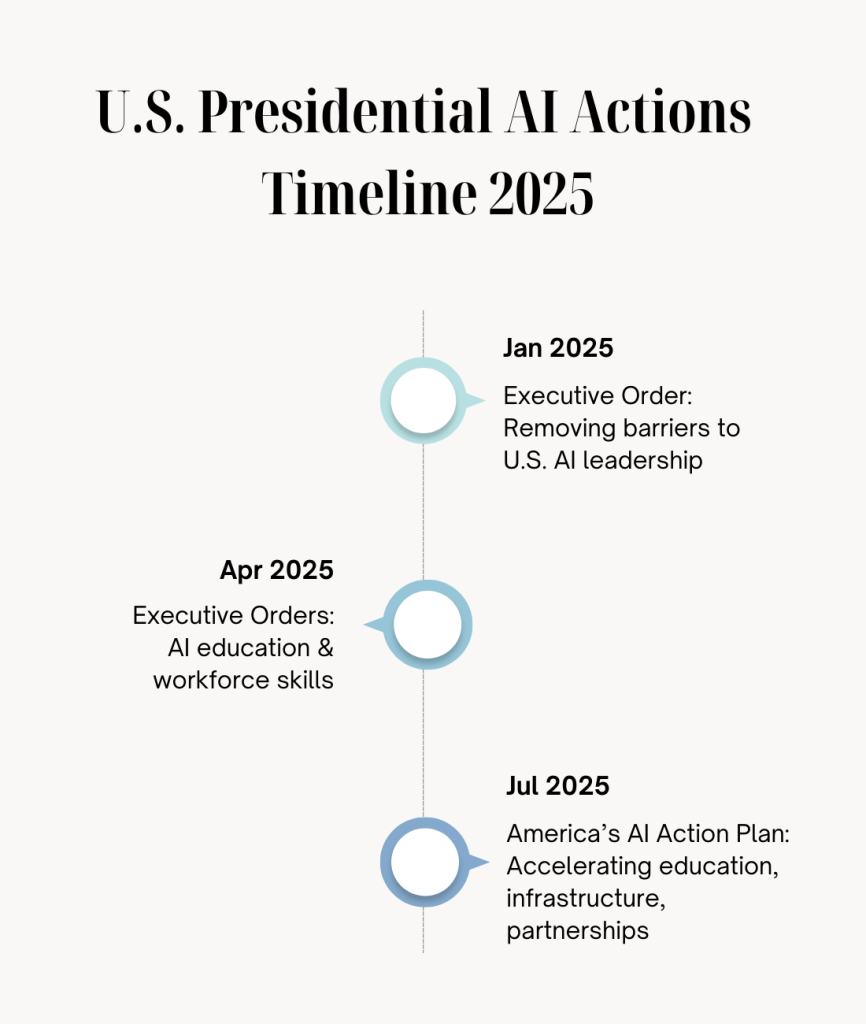
- America’s AI Action Plan (July 2025): Directs federal agencies to accelerate AI education, bolster domestic infrastructure, and expand public-private partnerships while guarding against “Orwellian” uses of AI.
- Executive Order to “remove barriers” to U.S. AI leadership (Jan 2025): Signals a deregulatory, pro-innovation posture across federal agencies.
- Education & workforce EOs (April 2025): The Action Plan references new executive orders focused on AI education for youth and skills for future jobs.
2) Convening the tech industry
The President and senior staff are actively engaging major tech leaders (Apple, Meta, Microsoft, Google, OpenAI and others) at the White House to align on AI education, innovation, and policy priorities – high-visibility meetings that also telegraph market confidence.
3) Standards, risk, and safety infrastructure
Rather than pause innovation, federal bodies are leaning on NIST’s AI Risk Management Framework (AI RMF) and its new profiles to guide safe deployment across government and industry – an approach that favors practical risk controls over prescriptive bans.
The White House has emphasized the importance of developing clear standards and a robust risk management framework to guide the safe deployment of artificial intelligence. This approach favors practical risk controls over prescriptive bans, aligning with broader global discussions on responsible AI and ensuring that innovation continues while maintaining public trust.
4) Federal procurement and pilots
Agencies are being encouraged to adopt proven, commercial-grade AI. Partnerships like Palantir + Accenture Federal Services are designed to deliver AI-enabled decision support “into the fabric of government agencies,” speeding real-world use cases.
5) Legislative engagement
On Capitol Hill, measures such as the CREATE AI Act of 2025 (to expand national AI research resources) indicate bipartisan momentum to fund compute, data, and research access – complementing executive actions. States are also moving fast, with dozens of new AI measures in 2025.
How the Administration Supports AI in Practice
- Finance and incentives: Prioritize AI-relevant infrastructure in federal budgets and encourage private capex through procurement commitments.
- Standards & guidance: Scale AI RMF adoption across agencies; publish domain-specific profiles (e.g., for generative AI and human-rights-aware deployments).
- Talent & skills: Expand AI education and workforce programs (youth, trades, upskilling) via executive directives and interagency coordination.
- Public-private pilots: Use OTAs, FAR flexibilities, and challenge programs to trial AI systems in defense, health, logistics, and citizen services (e.g., the Palantir-AFS federal partnership).
Industry convenings: Maintain structured dialogue with CEOs and researchers to align on compute, safety, and deployment hurdles.
Why This Support Matters
- Global competitiveness: National strategy + agency alignment reduces policy friction, accelerating time-to-market for AI breakthroughs and infrastructure.
- Pragmatic safety: Using the AI RMF builds a common language for risk without stifling innovation, giving enterprises clearer guardrails.
- Government as lead customer: Federal procurement validates AI products and catalyzes broader adoption across the economy.
International Ripple Effects
U.S. positioning often shapes global norms. A White House emphasis on pro-innovation with managed risk – anchored in NIST guidance – nudges allies and partners toward compatible standards and interoperable assurance regimes. Countries tracking U.S. policy (and U.S.-based vendors) are likely to mirror elements of RMF-style risk management, boost their own AI funding, and court American firms for joint projects and data-center builds.
The administration’s policies are already sparking global ripple effects, as countries follow U.S. initiatives and boost AI investments. This highlights how American leadership can shape standards and accelerate adoption, driving AI’s broad impact across sectors, from healthcare to manufacturing.
Conclusion: What to Expect Next
The administration’s approach – pairing deregulatory signals and executive direction with NIST-anchored safety practices and aggressive industry engagement – suggests the U.S. will scale AI deployment across agencies while courting private investment in compute, data centers, and models. Expect expanded federal pilots, additional AI-education initiatives, and closer alignment with allies on standards. Other governments are likely to respond with their own investment plans and risk frameworks, creating a de facto competition of playbooks – but with growing interoperability wherever the U.S. AI RMF becomes the common spine.
AI and the White House: Key Questions Answered
What is the America’s AI Action Plan?
The America’s AI Action Plan is a national roadmap launched by the White House in 2025 to expand AI education, strengthen infrastructure, and drive innovation while addressing risks.
Why is the U.S. President supporting AI?
The administration views AI as critical for economic growth, national security, and global competitiveness, making federal support essential for leadership.
How does the White House work with big tech companies on AI?
The President meets regularly with leaders from Apple, Meta, Microsoft, Google, and OpenAI to align on AI innovation, policy, and education priorities.
What role does NIST play in AI regulation?
NIST’s AI Risk Management Framework (AI RMF) provides standards for safe AI deployment, balancing innovation with practical risk controls.
What federal agencies are adopting AI in 2025?
Agencies across defense, healthcare, logistics, and citizen services are piloting AI solutions through partnerships with companies like Palantir and Accenture Federal Services.
Why is U.S. AI policy important globally?
Because U.S. standards and policies often set global benchmarks, shaping how allies and partners adopt AI frameworks and risk management practices.
Related Reading
AI & Ethics: Rules, Violations, and What Responsible AI Looks Like