By April 2026, the global conversation around artificial intelligence has shifted dramatically from mere innovation to rigorous accountability. A recent report by the AI Governance Institute (AIGI) estimates that **regulatory fines and legal settlements related to AI ethics breaches have collectively surpassed $1.8 billion worldwide in Q1 2026 alone**, a 60% increase from the same period last year. This isn't just about headline-grabbing penalties; it's a clear signal that the era of "move fast and break things" in AI is definitively over. Companies are now facing immense pressure to integrate ethical considerations at every stage of their AI lifecycle, from data collection to deployment.
TL;DR: In April 2026, AI ethics is no longer a theoretical debate but a critical business imperative, driven by escalating regulations, significant financial penalties, and a demand for responsible AI from consumers and governments alike. This article explores the current regulatory landscape, key ethical challenges, major company initiatives, and practical implications for professionals, offering insights into what to expect in the latter half of 2026.
As AI tools become ubiquitous – from advanced coding assistants to sophisticated content generators – the stakes for ensuring they operate fairly, transparently, and securely have never been higher. The question is no longer *if* you need an AI ethics strategy, but *how robust* and *how integrated* it is into your core operations.
The Evolving Landscape of AI & Ethics in 2026
The regulatory environment surrounding AI ethics has matured significantly since the early 2020s, transforming from nascent guidelines into concrete, enforceable laws. The EU AI Act, fully effective across all member states since late 2025, now stands as the global gold standard, imposing stringent requirements on high-risk AI systems. This includes mandatory human oversight, robust data governance, and comprehensive risk assessments, with fines reaching up to €35 million or 7% of a company's global annual revenue for serious non-compliance. This framework has spurred a wave of similar legislative efforts globally, influencing policy in Canada, Brazil, and even certain US states.
In the United States, while a comprehensive federal AI law remains elusive, the Biden Administration's Executive Order on Safe, Secure, and Trustworthy AI (October 2023) has catalyzed significant agency action. The National Institute of Standards and Technology (NIST) has rolled out updated versions of its AI Risk Management Framework, now widely adopted by federal contractors and many private enterprises. The Federal Trade Commission (FTC) and the Department of Justice (DOJ) have been particularly active, targeting deceptive AI practices, data privacy violations, and algorithmic discrimination. For instance, in January 2026, the FTC levied a $45 million fine against "InsightAI," a predictive hiring platform, for demonstrably biased resume screening algorithms that systematically disadvantaged female applicants and minorities, leading to a class-action lawsuit settlement exceeding $120 million later that quarter.
Beyond the West, China's intricate web of AI regulations, particularly those concerning generative AI and algorithmic recommendations, continues to evolve, emphasizing content moderation and national security. India is also drafting its own comprehensive AI framework, focusing on data sovereignty and ethical use in public services. This global patchwork of regulations means that any company operating internationally must navigate a complex web of compliance requirements, often leading to the adoption of the highest common denominator in ethical standards.
Key Pillars of Responsible AI Development
Building responsible AI is not a singular task but an ongoing commitment to several core principles. These pillars form the bedrock of ethical AI systems and are increasingly mandated by regulators and expected by users.
Data Privacy and Security: The Foundation of Trust
Data is the lifeblood of AI, and its ethical handling is paramount. In 2026, privacy-enhancing technologies (PETs) like federated learning and differential privacy are becoming mainstream, allowing AI models to be trained on sensitive data without direct exposure. However, breaches remain a significant concern. In Q4 2025, "HealthGen AI," a medical diagnostic tool, faced a $75 million fine from European regulators after a misconfigured cloud database exposed anonymized patient data that was subsequently re-identified. This highlighted the continuous need for robust encryption, access controls, and regular security audits. Companies are now investing heavily in privacy-by-design methodologies, ensuring that data protection is baked into the system from conception, not added as an afterthought. For those building custom AI solutions, understanding secure data pipelines is as crucial as the code itself. Tools that help in secure data handling are becoming indispensable, especially for developers working with sensitive information. Learn more about secure development practices with our guide to best AI coding assistants.
Algorithmic Fairness and Bias Mitigation
Algorithmic bias, often stemming from unrepresentative or historically skewed training data, continues to be a major ethical challenge. In early 2026, a prominent mortgage lending AI, "CreditSense," faced scrutiny when independent audits revealed it disproportionately flagged loan applications from certain zip codes associated with lower-income minority groups, even when individual financial metrics were strong. This led to a DOJ investigation and a mandated overhaul of their model. New tools leveraging synthetic data generation and advanced explainable AI (XAI) techniques are emerging to help identify and mitigate these biases *before* deployment. Ethical AI auditing firms, like "Ethical AI Partners" (which secured $50 million in Series B funding in February 2026), are seeing booming demand, offering independent assessments of AI systems for fairness, transparency, and robustness. These audits often involve counterfactual explanations and perturbation testing to understand how different inputs affect outcomes.
Transparency and Explainability (XAI)
The "black box" problem – where AI decisions are opaque and difficult to understand – is no longer acceptable for high-stakes applications. Regulators, particularly under the EU AI Act, are demanding greater transparency, requiring clear documentation of how AI systems work, their limitations, and the data used to train them. Explainable AI (XAI) technologies are critical here, providing insights into *why* an AI made a particular decision. For example, in medical diagnostics, an XAI system might not just predict a disease but also highlight the specific features in an image or patient record that led to that diagnosis, allowing human doctors to verify and build trust. This is crucial for accountability and for allowing users to challenge potentially unfair or incorrect decisions. The push for XAI extends to generative models as well, with increasing calls for provenance tracking and clear labeling of AI-generated content to combat misinformation.
Human Oversight and Accountability
While AI can automate complex tasks, the principle of human oversight remains fundamental. This means designing systems where humans can effectively monitor, intervene, and ultimately be held accountable for AI's actions. In late 2025, a fully autonomous supply chain optimization AI, "LogiFlow," caused significant disruption for a major retailer when it rerouted critical shipments based on an erroneous market prediction, costing the company an estimated $30 million in lost sales. The incident highlighted the dangers of completely removing human checks and balances. The focus in 2026 is on "human-in-the-loop" and "human-on-the-loop" systems, where AI acts as an assistant or recommender, and humans retain final decision-making authority, especially for high-impact decisions. Establishing clear lines of accountability within organizations for AI-driven outcomes is also becoming a legal and ethical necessity.
Major Players and Their Stances on AI & Ethics
The tech giants leading the AI race are also at the forefront of the ethics discussion, often balancing rapid innovation with public and regulatory pressure.
Google/Alphabet: Responsible AI & Gemini's Evolution
Google continues to emphasize its "Responsible AI Principles," integrating them into product development. Following early 2024 controversies with Gemini's image generation (which sometimes produced historically inaccurate depictions), Google invested heavily in refining its safety filters and bias detection algorithms. By April 2026, Gemini Ultra 1.5 boasts advanced safety features and more transparent content policies. Google's DeepMind division is also a leader in AI safety research, publishing extensively on alignment, interpretability, and robust AI. Their internal AI governance board, established in 2023, now includes external ethics experts, reflecting a commitment to broader accountability. For those comparing foundational models, the ethical safeguards are a key differentiator. See our breakdown of ChatGPT vs Gemini for more on their respective approaches.
OpenAI: Safety, Alignment, and Superalignment
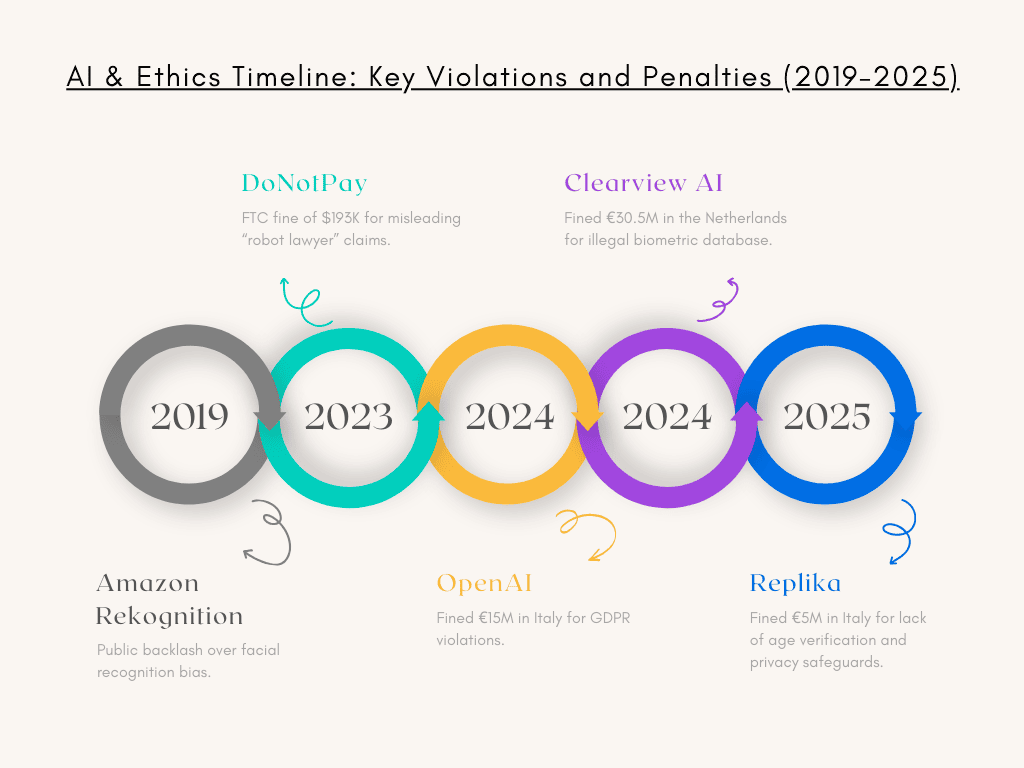
OpenAI, creator of ChatGPT and DALL-E, has made "safe and beneficial AGI" its core mission. They've invested billions in their Superalignment team, focused on ensuring future superintelligent AI aligns with human values. Their latest models, like GPT-5 and DALL-E 4 (released Q1 2026), feature significantly enhanced content moderation, guardrails against misuse (e.g., generating harmful misinformation or deepfakes), and more robust API usage policies. OpenAI often engages in public dialogue about AI safety, sometimes even slowing deployment of new features for further testing. However, their rapid commercialization still draws scrutiny, as seen with a $15M fine in Italy in 2024 for data collection practices and further investigations in 2025 regarding copyright infringement claims in training data.
Microsoft: AI for Good & Enterprise Governance
Microsoft has strategically positioned itself as a leader in "Responsible AI for Business," integrating ethical AI tools and governance frameworks into its Azure AI platform. Their Responsible AI Dashboard helps developers identify and mitigate issues like fairness and interpretability. Microsoft's partnerships with regulators and academic institutions aim to shape global AI policy. In Q3 2025, Microsoft announced a $500 million investment in "Ethical AI Acceleration Labs" to help enterprise clients integrate responsible AI practices. They emphasize human-centric design and have clear internal policies for developers using their tools, including those building best AI business tools.
Meta: Open-Source Dilemmas and Llama's Ethics
Meta's commitment to open-source AI, particularly with its Llama series, presents unique ethical challenges. While open-sourcing can accelerate innovation and democratize access, it also means less control over how models are used. Following the release of Llama 3.0 in 2025, Meta faced criticism for its slower response to instances of the model being fine-tuned for harmful purposes. In response, Meta announced its "Open Responsibility Initiative" in early 2026, pledging $100 million to fund research into open-source AI safety, model provenance tracking, and developing community-driven ethical guidelines for large language models. This move aims to balance the benefits of open innovation with the imperative for responsible deployment.
Comparison of Big Tech AI Ethics Stances (April 2026)
| Company |
Primary Focus |
Recent Ethical Challenge/Initiative |
Key Differentiator |
| Google/Alphabet |
Principle-driven, internal governance, advanced safety research |
Gemini's refined safety filters, external ethics board for AI governance. |
Comprehensive, integrated Responsible AI framework; strong academic ties. |
| OpenAI |
AGI safety, alignment, preventing misuse |
Superalignment team investment, enhanced DALL-E 4 content moderation. |
Deep theoretical research into future AI safety; proactive public discourse. |
| Microsoft |
Enterprise adoption, governance tools, industry partnerships |
$500M Ethical AI Acceleration Labs, Azure Responsible AI Dashboard. |
Practical, scalable solutions for businesses; strong regulatory engagement. |
| Meta |
Open-source safety, community guidelines, combating misuse |
Open Responsibility Initiative ($100M fund), Llama 3.0 misuse response. |
Balancing open innovation with distributed ethical governance. |
Financial and Reputational Costs of Ethical Lapses
The cost of neglecting AI ethics is no longer theoretical. Beyond the $1.8 billion in fines seen in Q1 2026, the ripple effects on a company's bottom line and public perception are profound.
Consider the case of "MediScan AI," a diagnostic imaging company. In mid-2025, it was revealed their AI system, used in hospitals across 15 countries, had a critical flaw: it systematically misdiagnosed a rare but aggressive form of cancer in patients with specific genetic markers, leading to delayed treatment and severe health outcomes. The subsequent lawsuits, regulatory investigations, and product recall cost MediScan AI over $500 million in settlements and lost revenue. Their stock plummeted by 40% in a week, and their brand reputation, built over decades, was irreparably damaged. This wasn't just a technical error; it was an ethical failure rooted in inadequate testing for fairness and a lack of transparency about model limitations.
Reputational damage extends beyond immediate financial penalties. A study by Edelman in late 2025 found that 78% of consumers are less likely to purchase from a company that has experienced a significant AI ethics scandal, even if the issue has been resolved. This "ethics premium" means that trust is now a critical competitive advantage. Companies that demonstrably prioritize responsible AI can attract top talent, secure more favorable regulatory treatment, and build stronger customer loyalty. Conversely, those that cut corners risk not just fines, but losing their market share to more ethically conscious competitors.
What This Means for You: Roles in the Ethical AI Ecosystem
The shift towards responsible AI has profound implications across various professional roles, creating new demands and opportunities.
For Developers & Engineers
Your role has expanded beyond writing efficient code. You are now on the front lines of ethical AI development. This means understanding and implementing privacy-preserving techniques, building robust testing frameworks for bias detection, and designing for interpretability. You'll work closely with ethical AI auditors and data scientists to ensure your models are fair, transparent, and secure. Proficiency in ethical AI toolkits and frameworks (like Google's What-If Tool or IBM's AI Fairness 360) is becoming a core skill. The demand for developers who can write secure, ethical, and performant AI is skyrocketing. If you're looking to enhance your skills, exploring best AI coding assistants that integrate ethical checks can be a game-changer.
For Product Managers & Business Leaders
You are responsible for championing ethical AI from strategy to deployment. This involves integrating ethical considerations into the product roadmap, conducting thorough risk assessments (e.g., privacy impact assessments, algorithmic impact assessments), and ensuring compliance with evolving regulations. Building an ethical AI culture within your organization, allocating resources for responsible AI initiatives, and clearly defining accountability structures are crucial. Ethical AI is no longer a "nice-to-have" but a strategic imperative that directly impacts market viability and brand trust. Leveraging best AI business tools that incorporate ethical governance features can streamline this process.
For Marketers & Content Creators
The rise of generative AI tools brings unique ethical challenges. You must be acutely aware of issues like deepfakes, misinformation, copyright infringement, and brand reputation risks associated with AI-generated content. Transparency is key: clearly labeling AI-generated content (e.g., using C2PA standards for provenance) is becoming a best practice. Understanding the ethical guidelines of tools like Jasper AI or Copy.ai is essential to avoid reputational damage. Exploring tools like Jasper AI and knowing its ethical guardrails, or understanding the capabilities of best AI headshot generators to avoid misuse, is critical for responsible content creation.
For Data Scientists & Researchers
Your expertise in data is more critical than ever for ethical AI. This means meticulously curating datasets for representativeness, developing advanced techniques for bias detection and mitigation, and creating explainable AI models. You'll be at the forefront of developing new metrics for fairness, privacy, and transparency. The demand for data scientists with a strong ethical compass and specialized knowledge in responsible AI methodologies is growing exponentially.
For Consumers
As AI becomes more integrated into daily life, understanding your rights and the ethical implications of the AI tools you use is vital. This includes knowing how your data is collected and used, understanding the potential for algorithmic bias in services you rely on, and knowing how to challenge AI-driven decisions. Advocating for stronger regulations and supporting companies with clear ethical commitments will shape the future of AI. To make informed choices, you might find our AI tool finder quiz helpful in navigating the ethical landscape of various AI applications.
Navigating the Future: What to Watch in Late 2026
The latter half of 2026 promises continued evolution in the AI & Ethics space. Here are key trends to monitor:
- US Federal AI Legislation Progress: Expect continued momentum towards a comprehensive federal AI law in the United States, potentially moving beyond executive orders to codify stronger protections for data privacy, algorithmic fairness, and transparency. Bipartisan efforts are likely to focus on specific high-risk sectors like employment, healthcare, and finance.
- Advanced Explainable AI (XAI) and Auditing: Breakthroughs in XAI will make AI decisions even more interpretable, moving beyond simple feature importance to causal explanations. Independent ethical AI auditing will become a standard practice, with new certifications and accreditation bodies emerging. Look for specialized firms offering services to compare AI tools not just on performance, but also on their ethical footprint.
- Global Harmonization (or Fragmentation) of Regulations: While the EU AI Act sets a benchmark, other regions will continue to develop their own frameworks. The challenge will be to find common ground for international businesses, potentially leading to global standards for data provenance and AI safety. However, geopolitical tensions could also lead to further fragmentation.
- Focus on AI in Critical Infrastructure: As AI is deployed in energy grids, transportation, and defense, the ethical implications of system failures, cyberattacks, and autonomous decision-making will come under intense scrutiny. Expect stricter regulations and robust testing requirements for AI in these high-impact areas.
- Ethical Implications of AGI Development: As AI capabilities continue to advance, the long-term ethical and societal implications of Artificial General Intelligence (AGI) will move from theoretical discussion to more concrete policy debates, prompting discussions around control, alignment, and societal impact.
- Rise of AI Ethics as a Service (EaaS): More companies will emerge offering specialized AI ethics consulting, auditing, and compliance tools, making it easier for organizations of all sizes to integrate responsible AI practices without building massive internal teams.
The journey towards truly responsible AI is complex and ongoing. It requires continuous vigilance, proactive policy-making, and a collective commitment from developers, businesses, and governments to prioritize human well-being and societal benefit above all else. The ethical choices we make today will shape the AI-driven world of tomorrow.
Frequently Asked Questions
What is "Responsible AI" in 2026?
In 2026, Responsible AI refers to the development, deployment, and governance of AI systems in a manner that is fair, transparent, accountable, secure, privacy-preserving, and beneficial to society. It involves proactively identifying and mitigating risks such as bias, discrimination, privacy breaches, and misuse, while ensuring human oversight and control.
How have AI ethics regulations changed since 2025?
Since 2025, the EU AI Act has become fully enforceable, setting a global precedent for comprehensive AI regulation, particularly for high-risk systems. In the US, the Executive Order on AI has spurred more aggressive enforcement actions by agencies like the FTC and DOJ, and there's increased momentum for federal legislation. Globally, more countries are developing their own AI frameworks, leading to a complex but increasingly structured regulatory landscape.
What are the biggest ethical challenges facing generative AI in 2026?
The biggest ethical challenges for generative AI in 2026 include combating sophisticated misinformation and deepfakes, addressing copyright infringement claims from training data, ensuring transparency and clear labeling of AI-generated content, preventing the creation of harmful or biased content, and managing the environmental impact of large model training.
What are the financial consequences of AI ethics violations?
The financial consequences of AI ethics violations are substantial and growing. In Q1 2026 alone, global fines and settlements exceeded $1.8 billion. These costs include direct regulatory fines (e.g., up to €35M under the EU AI Act), legal settlements from class-action lawsuits, product recalls, loss of intellectual property, and significant reputational damage that can lead to decreased sales, stock price drops, and difficulty attracting talent.
How can individuals and businesses ensure they are using AI ethically?
Individuals should educate themselves on AI's capabilities and limitations, demand transparency from AI providers, and understand their data rights. Businesses should implement robust AI governance frameworks, conduct regular ethical AI audits, prioritize privacy-by-design, ensure human oversight, train employees on ethical AI principles, and be transparent with users about their AI systems. Utilizing specialized AI ethics tools and consulting services can also be beneficial.
What role does Explainable AI (XAI) play in current ethical practices?
XAI is crucial for ethical AI practices in 2026 because it addresses the "black box" problem, making AI decisions understandable to humans. This transparency is vital for accountability, allowing users to challenge decisions, identify biases, and build trust. Regulators increasingly mandate XAI for high-risk AI systems, ensuring that organizations can explain why an AI made a particular decision, which is fundamental for compliance and ethical deployment.