The beauty industry is one of the fastest adopters of artificial intelligence. From personalized skincare recommendations to AI-generated product formulations, technology is changing how consumers discover and use beauty products.
AI-Powered Skin Analysis
Modern AI tools can analyze photos of your skin and identify concerns like dryness, uneven texture, or signs of aging. These tools recommend specific ingredients and routines tailored to your skin type, removing the guesswork from building an effective skincare regimen.
Brands that embrace this technology give customers a more personalized shopping experience. Mirai Skin, for example, combines Korean beauty expertise with technology-driven product recommendations to help customers find the right products for their skin concerns.
AI in Product Development
Beauty brands use AI to analyze ingredient databases, predict how formulations will perform, and identify trending ingredients before they go mainstream. This speeds up product development from years to months.
K-beauty brands have been especially innovative in this space. Their approach of layering multiple targeted products – essences, serums, ampoules – maps well to AI-driven personalization where each step addresses a specific skin concern identified by analysis.
Daily Routines and AI Recommendations
AI assistants now help people build and maintain daily skincare routines. You describe your skin goals and concerns, and the AI suggests a step-by-step routine with specific product types for morning and evening. This is particularly useful for K-beauty routines which can involve 5-10 steps.
For recommendations on AI tools that can help with this, try our AI Tool Finder Quiz – it matches you with the right AI assistant for any use case including health and beauty research.
The Future of AI in Beauty
Expect to see more brands offering virtual try-on experiences, AI-generated ingredient combinations, and real-time skin monitoring through smartphone cameras. The beauty industry AI market is projected to grow significantly through 2027.
FAQ
Can AI accurately analyze my skin type?
AI skin analysis tools have become quite accurate, especially when using high-quality photos in good lighting. However, they work best as a starting point – a dermatologist can provide deeper analysis for specific skin conditions.
Are AI-recommended skincare products effective?
AI recommendations are based on ingredient research and user data, so they tend to be well-matched to stated concerns. Results still depend on product quality and consistency of use.
What AI tools can help with skincare research?
General-purpose AI chatbots like ChatGPT and Claude can research ingredients and explain their benefits. For product comparisons and reviews, specialized beauty platforms and honest review sites provide the most practical guidance.
For years, artificial intelligence was framed as a Q&A machine – ask a question, get an answer. But 2025 is redefining the field. We’ve entered the era of Autonomous AI Agents: systems that don’t just answer questions but perform complex, multi-step tasks autonomously – a shift that brings fresh urgency to debates around responsible AI and ethical guardrails in deployment. These agents are quickly becoming the invisible workforce behind everything from scheduling meetings to running online stores, reshaping how businesses and individuals operate.e
Smarter Than a Calendar: Agents as Personal Organizers
Imagine telling your assistant, “Set up a meeting with Sarah and Daniel next week.” Instead of simply dropping a reminder, an AI agent checks everyone’s availability across multiple calendars, identifies the best time, books the slot, and even sends out invites. Tools like Microsoft Copilot and Google’s Gemini-powered Workspace integrations are already experimenting with this, blending natural conversation and autonomous action – signaling how autonomous AI agents are redefining workflows. See how this contrasts with broader trends in AI investment by tech giants.
Reinventing E-Commerce: From Shopping to Self-Managing Stores
In e-commerce, autonomous agents are becoming full-scale operations managers. A business owner no longer needs to track inventory, adjust prices, or manually design promotions. Instead, an AI agent monitors stock levels, compares competitor pricing, and launches personalized campaigns. Amazon’s Nova Agents are pioneering this approach by combining multimodal AI with automation, allowing sellers to scale without additional staff.
Beyond Chatbots: Agents as Customer Experience Architects
Customer service is being redefined by agents that not only answer queries but take action. Picture a client contacting a telecom provider to complain about a billing issue. Instead of transferring to a human, an AI agent accesses the CRM, reviews the account, applies a refund if needed, and sends an updated invoice. OpenAI’s GPT-4o, with its multimodal capabilities, is one of the first systems to showcase this level of integration.
Everyday Autonomy: Agents in the Home
The real revolution is how these agents slide seamlessly into everyday life. Smart home ecosystems are evolving beyond simple commands like “turn on the lights.” A modern AI agent recognizes when you wake up, brews your coffee, adjusts the thermostat based on the weather, and suggests a playlist suited to your mood. Companies like Apple are investing in edge-optimized multimodal models, such as FastVLM, that make this possible directly on devices.
Why Autonomous AI Agents Matter – and Where They’re Headed
The real innovation is not just that these systems act, but that they learn to act better over time. Unlike traditional automation, autonomous agents plan, evaluate, and adapt in ways that mimic human reasoning. They don’t simply complete tasks; they strategize. In healthcare, this could mean managing patient data while also coordinating follow-up treatments. In business, agents may run entire workflows, from drafting proposals to scheduling meetings and monitoring performance. And in everyday life, they quietly handle the countless micro-decisions that drain our attention.
This is why industry analysts forecast explosive growth: the global AI agent market is expected to expand at a compound annual growth rate of over 40% through 2032, with enterprise adoption driving the curve. By 2030, experts predict that more than half of daily digital interactions will be executed by AI agents rather than humans.The Bottom Line Autonomous AI agents represent the next chapter of artificial intelligence – not passive responders, but active doers. They’re transforming medicine, commerce, customer service, and even the routines of daily life. The question is no longer whether AI will act on our behalf, but how quickly we’ll let it take the wheel.
Frequently Asked Questions About Autonomous AI Agents
How safe is it to trust agents with sensitive data?
Safety depends on design. Companies like OpenAI and Google are investing heavily in privacy-first architectures and on-device processing to ensure sensitive information never leaves your ecosystem. According to Gartner, by 2027 more than 75% of enterprises will mandate AI governance frameworks to mitigate risks.
Can AI agents really make decisions on their own?
Yes, but within boundaries. Agents follow programmed objectives but use reasoning models to adapt their actions. For example, an e-commerce agent may lower prices automatically based on competitor trends but stays within parameters set by the business owner.
What makes AI agents different from chatbots?
Chatbots answer questions; agents perform tasks. For example, instead of just explaining how to reset a password, an AI agent can log into the system, reset it, and send you the new credentials.
Are AI agents already being used in healthcare?
Yes. Hospitals are testing AI agents for scheduling patient appointments, processing medical records, and even triaging emergency cases. Some pilot programs reduced administrative workload for doctors by 25%, freeing more time for patient care.
Can AI agents collaborate with each other?
Absolutely. Emerging frameworks like AutoGen allow multiple agents to coordinate on tasks. For example, one agent drafts a business plan, another analyzes financial models, and a third creates a marketing strategy – working together seamlessly.
The current U.S. administration has framed artificial intelligence as a strategic lever for economic growth, national security, and global competitiveness. The White House’s America’s AI Action Plan sets out a national roadmap for innovation, skills, and infrastructure – explicitly positioning AI as a domain the U.S. must lead.
How the President Is Supporting AI
1) Executive actions and national strategy
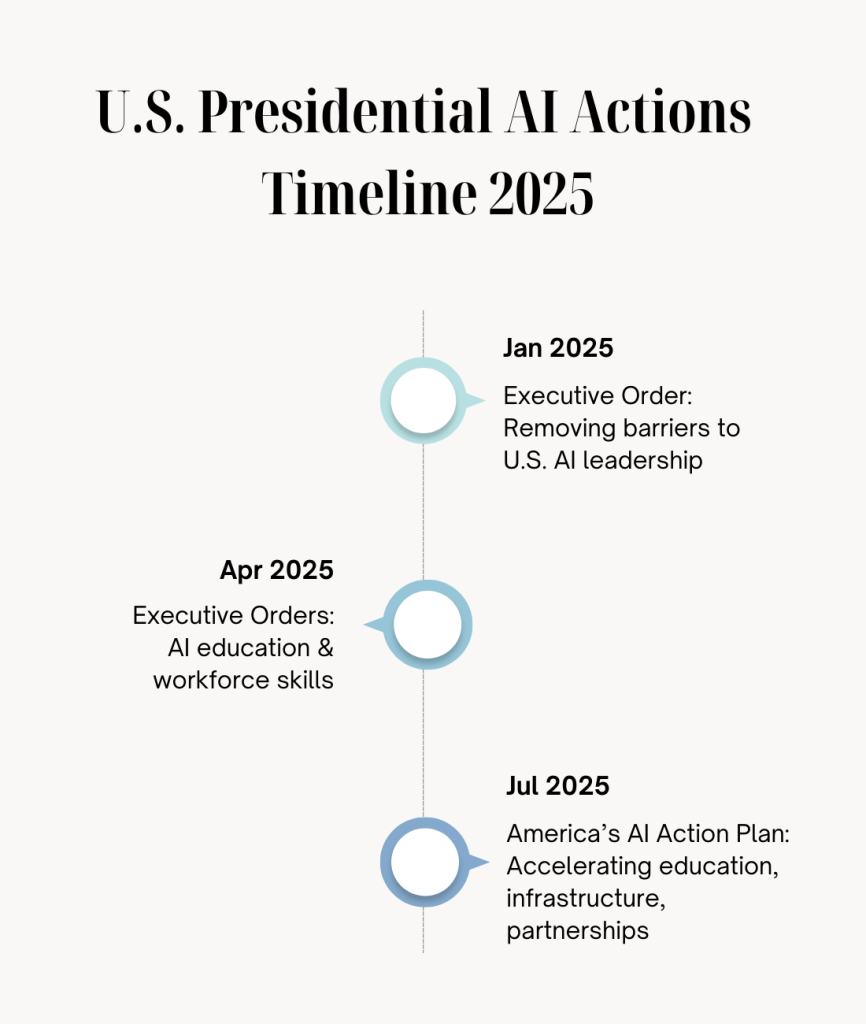
America’s AI Action Plan (July 2025): Directs federal agencies to accelerate AI education, bolster domestic infrastructure, and expand public-private partnerships while guarding against “Orwellian” uses of AI.
Executive Order to “remove barriers” to U.S. AI leadership (Jan 2025): Signals a deregulatory, pro-innovation posture across federal agencies.
Education & workforce EOs (April 2025): The Action Plan references new executive orders focused on AI education for youth and skills for future jobs.
2) Convening the tech industry
The President and senior staff are actively engaging major tech leaders (Apple, Meta, Microsoft, Google, OpenAI and others) at the White House to align on AI education, innovation, and policy priorities – high-visibility meetings that also telegraph market confidence.
3) Standards, risk, and safety infrastructure
Rather than pause innovation, federal bodies are leaning on NIST’s AI Risk Management Framework (AI RMF) and its new profiles to guide safe deployment across government and industry – an approach that favors practical risk controls over prescriptive bans.
The White House has emphasized the importance of developing clear standards and a robust risk management framework to guide the safe deployment of artificial intelligence. This approach favors practical risk controls over prescriptive bans, aligning with broader global discussions on responsible AI and ensuring that innovation continues while maintaining public trust.
4) Federal procurement and pilots
Agencies are being encouraged to adopt proven, commercial-grade AI. Partnerships like Palantir + Accenture Federal Services are designed to deliver AI-enabled decision support “into the fabric of government agencies,” speeding real-world use cases.
5) Legislative engagement
On Capitol Hill, measures such as the CREATE AI Act of 2025 (to expand national AI research resources) indicate bipartisan momentum to fund compute, data, and research access – complementing executive actions. States are also moving fast, with dozens of new AI measures in 2025.
How the Administration Supports AI in Practice
Finance and incentives: Prioritize AI-relevant infrastructure in federal budgets and encourage private capex through procurement commitments.
Standards & guidance: Scale AI RMF adoption across agencies; publish domain-specific profiles (e.g., for generative AI and human-rights-aware deployments).
Talent & skills: Expand AI education and workforce programs (youth, trades, upskilling) via executive directives and interagency coordination.
Public-private pilots: Use OTAs, FAR flexibilities, and challenge programs to trial AI systems in defense, health, logistics, and citizen services (e.g., the Palantir-AFS federal partnership).
Industry convenings: Maintain structured dialogue with CEOs and researchers to align on compute, safety, and deployment hurdles.
Why This Support Matters
Global competitiveness: National strategy + agency alignment reduces policy friction, accelerating time-to-market for AI breakthroughs and infrastructure.
Pragmatic safety: Using the AI RMF builds a common language for risk without stifling innovation, giving enterprises clearer guardrails.
Government as lead customer: Federal procurement validates AI products and catalyzes broader adoption across the economy.
International Ripple Effects
U.S. positioning often shapes global norms. A White House emphasis on pro-innovation with managed risk – anchored in NIST guidance – nudges allies and partners toward compatible standards and interoperable assurance regimes. Countries tracking U.S. policy (and U.S.-based vendors) are likely to mirror elements of RMF-style risk management, boost their own AI funding, and court American firms for joint projects and data-center builds.
The administration’s policies are already sparking global ripple effects, as countries follow U.S. initiatives and boost AI investments. This highlights how American leadership can shape standards and accelerate adoption, driving AI’s broad impact across sectors, from healthcare to manufacturing.
Conclusion: What to Expect Next
The administration’s approach – pairing deregulatory signals and executive direction with NIST-anchored safety practices and aggressive industry engagement – suggests the U.S. will scale AI deployment across agencies while courting private investment in compute, data centers, and models. Expect expanded federal pilots, additional AI-education initiatives, and closer alignment with allies on standards. Other governments are likely to respond with their own investment plans and risk frameworks, creating a de facto competition of playbooks – but with growing interoperability wherever the U.S. AI RMF becomes the common spine.
AI and the White House: Key Questions Answered
What is the America’s AI Action Plan?
The America’s AI Action Plan is a national roadmap launched by the White House in 2025 to expand AI education, strengthen infrastructure, and drive innovation while addressing risks.
Why is the U.S. President supporting AI?
The administration views AI as critical for economic growth, national security, and global competitiveness, making federal support essential for leadership.
How does the White House work with big tech companies on AI?
The President meets regularly with leaders from Apple, Meta, Microsoft, Google, and OpenAI to align on AI innovation, policy, and education priorities.
What role does NIST play in AI regulation?
NIST’s AI Risk Management Framework (AI RMF) provides standards for safe AI deployment, balancing innovation with practical risk controls.
What federal agencies are adopting AI in 2025?
Agencies across defense, healthcare, logistics, and citizen services are piloting AI solutions through partnerships with companies like Palantir and Accenture Federal Services.
Why is U.S. AI policy important globally?
Because U.S. standards and policies often set global benchmarks, shaping how allies and partners adopt AI frameworks and risk management practices.