

Transforming Years into Months with Smarter Research
Developing a new drug has long been one of the most time-consuming and expensive endeavors in science. On average, the journey from concept to approved medicine can take 10–15 years and cost over $2.6 billion. The majority of candidates fail in the late stages, draining time, resources, and hope.
AI as the Game-Changer
Artificial Intelligence is revolutionizing this process by turning years of lab work into months of computational discovery. With AI, researchers are able to analyze billions of molecules in just days instead of years, predict drug–target interactions with a level of accuracy never before possible, and significantly reduce the risk of failure in clinical trials by identifying potential toxicity issues at an early stage. Beyond that, AI accelerates the critical progression from the “hit to lead” phase all the way through to the “lead to candidate” stage, creating a streamlined path that saves both time and resources while improving the chances of success. However, this rapid progress also raises ethical considerations surrounding AI.
Key Benefits of AI-Driven Drug Discovery
- Speed – AI models generate and test drug candidates in silico before moving to costly lab experiments.
- Precision – Algorithms identify molecules with a high probability of success.
- Cost Reduction – Less wasted R&D, fewer failed trials.
- Scalability – AI can handle massive datasets that no human team could ever process.
- Personalization – Tailoring therapies to patient subgroups with predictive biomarkers.
AI Reshaping Drug Discovery: From Years to Months
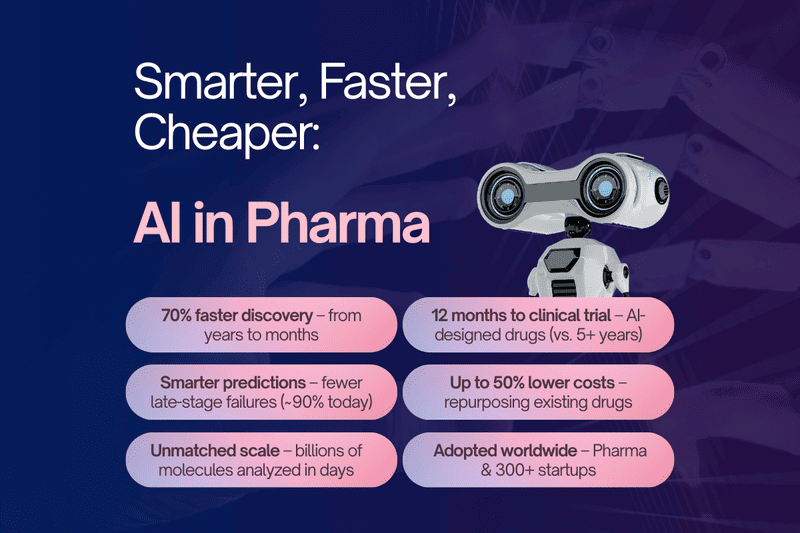
Recent data shows the revolutionary impact of AI in drug discovery. A 2024 study found that AI-assisted pipelines cut early discovery timelines by 70%. Exscientia developed the first AI-designed drug to reach human clinical trials in just 12 months – compared to over 5 years traditionally. AI is also repurposing existing drugs, reducing development costs by up to 50%, while predictive models help cut late-stage failure rates, which typically reach ~90%. As a result, adoption is accelerating: pharma giants like Pfizer, Novartis, and GSK are investing heavily, more than 300 biotech startups are building AI-first pipelines, and hospitals and research centers are leveraging AI to deliver personalized therapies for cancer and rare diseases.
FAQs – Everything You Wanted to Know
How does AI actually find new drugs?
By scanning databases of chemical compounds, predicting their behavior, and simulating interactions with biological targets.
Can AI really replace scientists?
No – AI is a tool. Scientists use AI to accelerate insights and focus on higher-value decision-making.
How much time can AI save in drug discovery?
It can reduce timelines from 10–15 years to as little as 2–4 years in some cases.
Is AI only for new drugs, or also existing ones?
Both. AI is widely used for drug repurposing, finding new applications for approved medicines.
Are there any approved AI-discovered drugs yet?
Yes, several AI-designed molecules are in clinical trials, and the first approvals are expected within the next 3–5 years.
How accurate is AI compared to traditional methods?
AI models can achieve up to 80–90% prediction accuracy, far higher than random screening.
Which diseases benefit most from AI discovery?
Cancer, neurological disorders, infectious diseases, and rare genetic conditions.
Will patients see faster access to life-saving drugs?
Yes, AI is expected to bring treatments to patients years sooner than traditional methods.
Final Word: The Future is AI-Accelerated
AI isn’t just a buzzword in pharma – it’s the engine powering the next wave of medical breakthroughs. From oncology to rare diseases, the ability to cut timelines, reduce failures, and lower costs is redefining what’s possible in global healthcare.
The age of waiting decades for new therapies is ending. With AI, the future of medicine is measured in months, not years.
Related Reading
AI in Robotics: The Next Leap in Physical Intelligence