



Last updated: April 7, 2026
A Disruption as Pervasive as the Early Internet
Artificial Intelligence is disrupting the labor landscape much like the internet did in the 1990s. As websites and email transformed business processes, AI today automates tasks once considered too complex – especially in entry-level roles. Analysts project that up to 50% of beginner-level positions may be eliminated or reshaped; meanwhile, others argue AI will create as many jobs as it replaces.
Roles That Are Disappearing – and the AI Tools Replacing Them
| Role | AI Tools | Impact |
| Customer Support Representatives | Chatbots like Ada, Forethought, Ultimate AI | Automates thousands of inquiries, reducing the need for human agents |
| Junior Web Developers | Base44, 10web, Shopify, Bluehost | Builds, debugs, and optimizes websites without needing entry-level devs |
| Content Writers | Jasper, Copy.ai, Writesonic, ChatGPT | Automates blog posts, product descriptions, SEO content at scale |
| Translators (Routine Text) | DeepL Write, GPT-4 Turbo, Claude 3 | Provides fast, high-quality translation – reducing need for junior translators |
| Graphic Designers & Video Editors | Capcut, Picsart, PicWish, Design Pickle | Creates visuals and short videos, replacing basic creative tasks |
| Market Research Assistants | ChatGPT with browsing, Crayon AI, Quid | Collects and summarizes market data, reducing roles for analysts |
Implications for the Workforce
Repetitive, execution-focused jobs – especially those at the entry level – are most at risk of automation. In contrast, roles requiring strategy, creativity, and emotional intelligence are becoming increasingly valuable. Firms once relying heavily on junior staff are transitioning toward smaller teams of skilled supervisors capable of guiding and optimizing AI systems.
Workforce Impact: Data and Projections for 2025
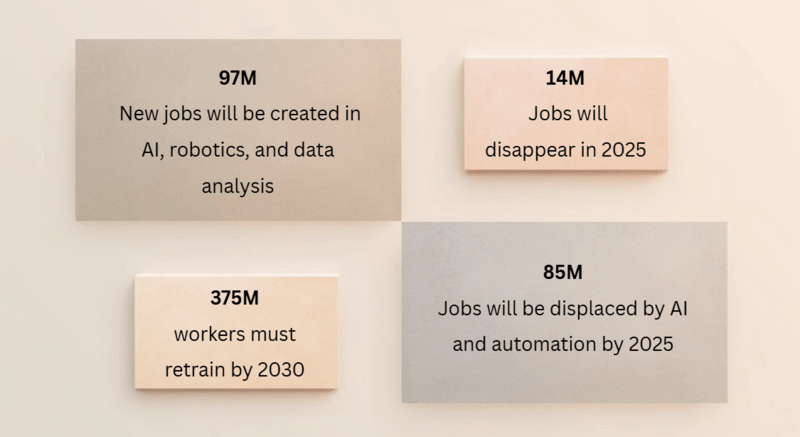
- Global Workforce Impact: AI and automation are set to displace 85 million jobs globally by 2025, while simultaneously creating 97 million new jobs in AI, robotics, and data analysis.
- Demand for Reskilling: An estimated 375 million jobs (14% of the global workforce) will require reskilling by 2030.
- Advanced Economies at Risk: Up to 60% of jobs in advanced economies may be exposed to AI automation, compared to just 26% in lower-income nations.
- Acceleration of Skill Required: Skills demanded for AI-exposed roles are changing 66% faster than those in non-AI roles.
- Immediate Displacement: In 2025, an estimated 14 million jobs worldwide and approximately 2.1 million U.S. jobs are expected to be displaced due to AI automation.
How AI Eases Workforce Stress
- Efficiency Over Displacement: The U.S. Federal Reserve notes that only 1% of service-sector firms report layoffs due to AI; in fact, 11% increased hiring and 34% retrained employees instead.
- Emerging Career Opportunities: Workforce transformations include new roles such as AI trainers, ethicists, model supervisors, and technicians – especially as creative and human-centric skills become paramount.
What to Expect in 2025
- Growing Demand for AI-Literate Skills: Employers will prioritize digital literacy, ethics, adaptability, and higher-order thinking more than ever.
- Shift to Skill-Based Hiring: Résumés emphasizing AI-relevant skills may become more valued than traditional degrees.
- More Sophisticated Role Evolution: Entry-level jobs may vanish – but mid- and high-skilled positions supported by AI will flourish (e.g., roles in AI oversight, governance, and creative collaboration).
- Policy & Education Play Crucial Roles: Governments and educational systems will need to invest more in training programs, certification initiatives, and career transition support.
AI isn’t just about replacing jobs – it’s about redefining work. While 2025 brings rapid changes, the story isn’t one of decline – it’s about how humans reshape the future of work through collaboration with AI.
AI and Jobs in 2025: Key Questions Answered
1. How many jobs will AI displace by 2025?
Analysts project that AI and automation will displace around 85 million jobs globally by 2025.
2. Will AI create new jobs as well?
Yes. While many jobs will be displaced, AI is expected to create around 97 million new jobs, especially in fields like robotics, AI training, and data analysis.
3. Which jobs are most at risk from AI automation?
Repetitive, execution-focused roles – such as customer support, junior web development, and routine content writing – are most vulnerable to automation.
4. How many workers will need reskilling because of AI?
By 2030, an estimated 375 million workers (14% of the global workforce) will require reskilling to adapt to AI-driven changes.
5. Which economies are most exposed to AI automation?
Up to 60% of jobs in advanced economies may be exposed to AI automation, compared to 26% in lower-income nations.
6. How fast are skill requirements changing due to AI?
Skills demanded for AI-exposed roles are changing 66% faster than those in non-AI roles, creating pressure for continuous learning.
7. How can companies reduce workforce stress caused by AI?
Instead of layoffs, many companies focus on reskilling and retraining. For example, the U.S. Federal Reserve found that only 1% of service firms reported layoffs, while 34% retrained employees.
8. How should individuals prepare for the future of work with AI?
Focus on AI literacy, adaptability, creativity, and emotional intelligence. Employers are expected to prioritize these higher-order skills over traditional degrees.
Related Reading
Best AI Productivity Tools in 2026: Work Smarter, Not Harder