

For years, using artificial intelligence felt like something reserved for data scientists, engineers, or big tech labs. But 2025 marks a turning point: AI now speaks your language – literally. You no longer need to understand the code behind the curtain. You just talk, and it understands.
From Code to Conversation
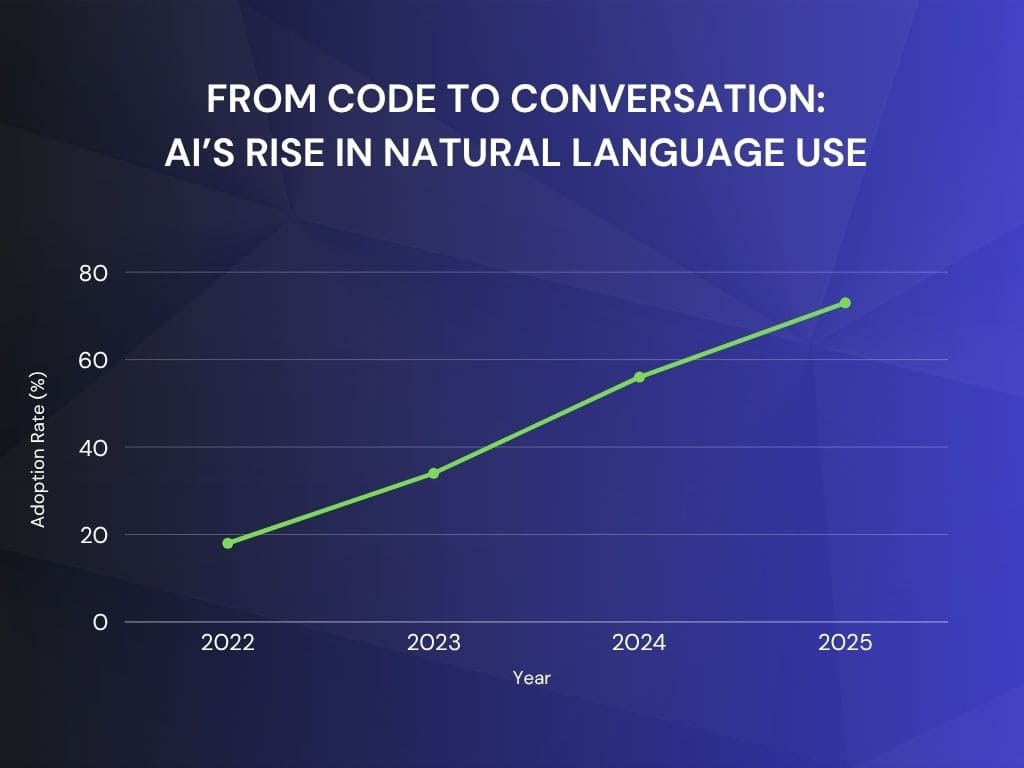
Generative AI models have evolved beyond syntax and logic. Today’s AI can interpret human language, tone, and even intent with astonishing precision. According to Stanford’s 2025 AI Usability Index, over 73% of new AI users engage through natural language interfaces – no technical background required.
In other words, you no longer need to translate your ideas into tech. The AI does the translating for you. Whether you’re a marketer, teacher, lawyer, or designer – you can communicate with AI just as you would with a colleague.
The Power of Natural Interaction
This shift changes everything. Instead of asking “How do I build an AI tool?” the new question is “What can AI build for me if I just explain it?”
This shift changes everything. Instead of asking “How do I build an AI tool?” the new question is “What can AI build for me if I just explain it?”
The result? AI democratization at scale.
- No need for a tech degree
- No need for “prompt engineering” jargon
- Just natural conversation and instant output
According to McKinsey’s 2025 AI Adoption Report, organizations that integrated conversational AI tools saw productivity gains of up to 42%, while reducing onboarding time for new employees by nearly 60%.
Your Ideas, Amplified by AI
Natural language AI acts as a creative amplifier. You describe your goal – “create a campaign,” “summarize this document,” “design a landing page” – and AI instantly delivers. Platforms like 10Web and Base44 showcase how simple language prompts can now generate fully designed websites and complete marketing campaigns in seconds, turning ideas into reality without technical barriers..
This isn’t about replacing human creativity; it’s about accelerating it. When humans focus on the idea, and AI handles the execution, innovation happens faster than ever.
Breaking the Language Barrier
AI’s new multilingual capabilities are another game-changer. Tools like Meta’s SeamlessM4T and OpenAI’s Whisper enable real-time speech translation in over 100 languages. That means someone in Tokyo can brainstorm in Japanese with a colleague in Berlin – and AI bridges the linguistic gap effortlessly.
It’s no longer “English-first” technology. It’s human-first.
The Future: Personalized Intelligence
The next wave of AI evolution is adaptive communication – systems that learn your style, your tone, and your context. Imagine an AI that knows how you write, how you think, and how you express emotion – and adjusts accordingly.
This is the frontier of what experts are calling “Linguistic Intelligence.”
By blending empathy, personalization, and natural dialogue, AI becomes not just a tool – but a thinking partner.
10 Innovative FAQs About “AI in Your Language”
What makes natural language AI different from traditional AI tools?
It eliminates the need for coding or technical prompts – you communicate using normal speech or text.
Can AI really understand tone or emotion?
Yes. Models like GPT-5 and Gemini 1.5 can detect emotional tone with over 90% accuracy in most major languages.
Is this technology multilingual?
Absolutely – modern AI systems now support more than 100 languages with contextual understanding, not just translation.
How does natural language AI help businesses?
It enables faster decision-making, reduces training time, and allows teams to use AI tools without technical barriers.
Will AI replace human jobs if it’s this easy to use?
Not replace – but transform. Roles evolve toward creativity, strategy, and innovation rather than repetitive execution.
What industries benefit most from natural language AI
Marketing, education, healthcare, customer service, and product design see the fastest adoption rates.
How secure is voice or text input for AI tools?
Top providers are implementing end-to-end encryption and privacy-by-design frameworks to protect user data.
Can I train AI to understand my personal writing style?
Yes. Many systems now allow for personalized fine-tuning to adapt to your tone, vocabulary, and preferences.
What’s next after natural language AI?
The rise of multimodal AI, combining text, voice, image, and gesture recognition – turning communication into a full sensory experience.
Why does this matter for everyday users?
Because AI is no longer a tech product – it’s a language interface. It listens, learns, and collaborates in the way humans naturally think and communicate.
Related Reading
Best AI Writing Tools for Bloggers in 2026