
Tag: Healthcare AI

AI Knowledge Hub

Explore our complete collection of articles, tutorials, and insights about AI tools and technology.

For decades, robots were viewed as machines built for repetitive tasks: assembling car parts, moving packages, or running fixed code. But 2025 marks a turning point. Google DeepMind has unveiled breakthrough models that allow robots to perform delicate, context-driven actions – from folding origami to setting a table based on voice instructions. This isn’t just automation anymore; it’s the dawn of AI-powered dexterity.

From Origami to Table Setting: Precision in Motion

DeepMind’s new Gemini Robotics models raise the bar for how robots interact with the physical world. Instead of executing rigid commands, these robots combine multimodal AI with natural language processing and visual understanding. That means they can fold intricate origami, close Ziploc bags without tearing them, and even set a dining table after being told, “Prepare the table for four.” By blending fine motor skills with contextual understanding, robots are moving closer than ever to human-level adaptability.

According to Engadget, Gemini-powered robots completed real-world tasks with an 85% higher success rate compared to earlier models.

From Controlled Labs to Real-World Impact

Until now, robots excelled mainly in controlled environments. DeepMind’s innovations are pushing them into homes, hospitals, and offices. The impact is already visible: more than 65% of manufacturers worldwide use AI-driven robots to reduce operational errors and cut costs by nearly 30%. By 2025, service robots in industries like healthcare and hospitality are expected to represent 34% of the global robotics market, valued at over $72 billion. In healthcare, Gemini robots are being tested for tasks such as preparing surgical equipment and assisting elderly patients, where delicate and adaptive movements are essential.
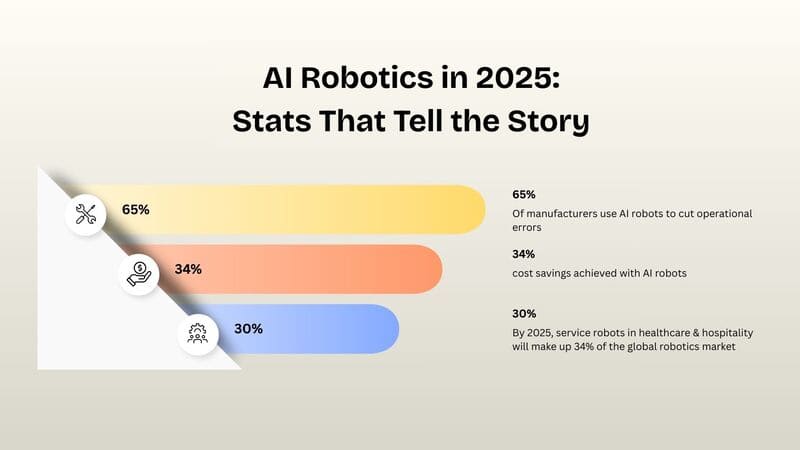
AI robotics stats 2025: 65% manufacturers use robots, 30% cost savings, 34% market share in services

Human-Robot Collaboration: Voice as the Bridge

The most exciting part of this evolution is how humans interact with robots. Instead of programming, you simply talk. You might say, “Place the spoon to the right of the plate,” or “Pack a lunch box with fruit, a sandwich, and a drink.” The robot interprets your intent, processes the environment in real time, and executes – without the need for step-by-step coding. This ease of interaction lowers the barrier to entry, making robotics accessible not only to businesses but also to everyday households.

The Bigger Picture: Robots With Brains and Hands

DeepMind’s Gemini Robotics shows us that the future of robotics lies in merging AI cognition with physical dexterity. These robots don’t just move – they learn new skills quickly without months of retraining, adapt dynamically to changes in objects, layouts, or commands, and collaborate safely with humans by understanding context and intent. In short, they are no longer just programmed workers but autonomous agents with both brains and hands.

Looking Ahead: A World of Adaptive Robots

As AI-powered robots become more common, their roles will expand across industries and everyday life. In hospitality, they’ll be capable of preparing rooms and creating personalized dining experiences. In healthcare, they’ll assist with surgical preparation and support patient mobility. And in our homes, they’ll help with chores, errands, and even creative activities like cooking. The line between human capability and robotic assistance is blurring – and it’s this seamless integration that makes the shift so revolutionary.

Frequently Asked Questions (FAQ) About AI in Robotics

What makes Google DeepMind’s breakthrough so special?

It’s the first time robots combine complex physical dexterity with real-time understanding of voice and vision.

Where will these robots be used first?

Healthcare, hospitality, and manufacturing are the leading sectors due to the need for precise, adaptable tasks.

Are robots like these safe to use around people?

Yes. Gemini robots are trained to understand human intent and avoid unsafe actions, making them safer collaborators.

How do they learn new skills?

By leveraging multimodal AI – integrating voice, vision, and context – they can learn from examples and adapt in real time.

What’s the biggest challenge ahead?

Scaling production while keeping costs manageable, along with addressing ethical concerns in sensitive industries.

Are service robots really gaining traction?

Absolutely. They already account for 34% of the global robotics market, particularly in healthcare and hospitality.

What does the future hold for AI in robotics?

Robots that don’t just follow commands but anticipate human needs, integrating naturally into our workplaces, hospitals, and homes.

Related Reading

Shortcuts in Drug Discovery with AI

Autonomous AI Agents: The Dawn of Self-Running Intelligence

AI Investment Surge by Tech Giants in 2025

Natalie Greene
Last updated: Apr 07, 2026
4 min read

Transforming Years into Months with Smarter Research

Developing a new drug has long been one of the most time-consuming and expensive endeavors in science. On average, the journey from concept to approved medicine can take 10–15 years and cost over $2.6 billion. The majority of candidates fail in the late stages, draining time, resources, and hope.

AI as the Game-Changer

Artificial Intelligence is revolutionizing this process by turning years of lab work into months of computational discovery. With AI, researchers are able to analyze billions of molecules in just days instead of years, predict drug–target interactions with a level of accuracy never before possible, and significantly reduce the risk of failure in clinical trials by identifying potential toxicity issues at an early stage. Beyond that, AI accelerates the critical progression from the “hit to lead” phase all the way through to the “lead to candidate” stage, creating a streamlined path that saves both time and resources while improving the chances of success. However, this rapid progress also raises ethical considerations surrounding AI.

Key Benefits of AI-Driven Drug Discovery

  1. Speed – AI models generate and test drug candidates in silico before moving to costly lab experiments.
  2. Precision – Algorithms identify molecules with a high probability of success.
  3. Cost Reduction – Less wasted R&D, fewer failed trials.
  4. Scalability – AI can handle massive datasets that no human team could ever process.
  5. Personalization – Tailoring therapies to patient subgroups with predictive biomarkers.

AI Reshaping Drug Discovery: From Years to Months

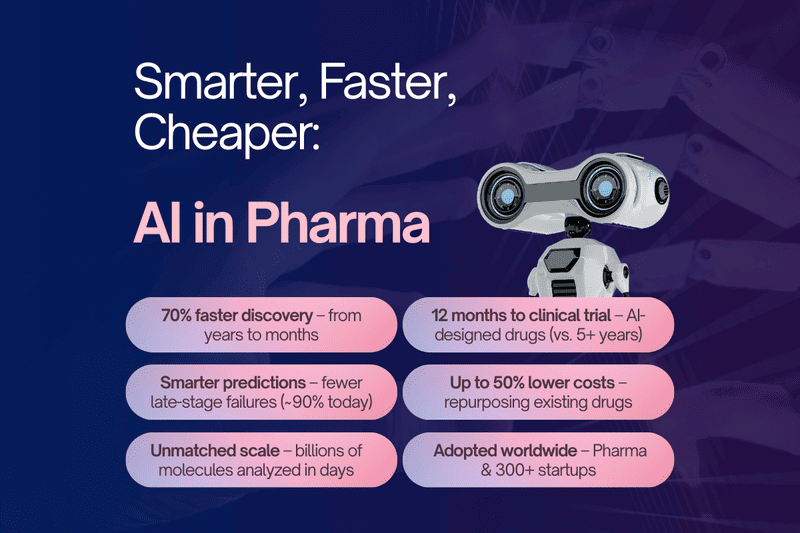
Recent data shows the revolutionary impact of AI in drug discovery. A 2024 study found that AI-assisted pipelines cut early discovery timelines by 70%. Exscientia developed the first AI-designed drug to reach human clinical trials in just 12 months – compared to over 5 years traditionally. AI is also repurposing existing drugs, reducing development costs by up to 50%, while predictive models help cut late-stage failure rates, which typically reach ~90%. As a result, adoption is accelerating: pharma giants like Pfizer, Novartis, and GSK are investing heavily, more than 300 biotech startups are building AI-first pipelines, and hospitals and research centers are leveraging AI to deliver personalized therapies for cancer and rare diseases.

Infographic on AI in Pharma highlighting faster drug discovery, lower costs, smarter predictions, unmatched scale, and global adoption

FAQs – Everything You Wanted to Know

How does AI actually find new drugs?

By scanning databases of chemical compounds, predicting their behavior, and simulating interactions with biological targets.

Can AI really replace scientists?

No – AI is a tool. Scientists use AI to accelerate insights and focus on higher-value decision-making.

How much time can AI save in drug discovery?

It can reduce timelines from 10–15 years to as little as 2–4 years in some cases.

Is AI only for new drugs, or also existing ones?

Both. AI is widely used for drug repurposing, finding new applications for approved medicines.

Are there any approved AI-discovered drugs yet?

Yes, several AI-designed molecules are in clinical trials, and the first approvals are expected within the next 3–5 years.

How accurate is AI compared to traditional methods?

AI models can achieve up to 80–90% prediction accuracy, far higher than random screening.

Which diseases benefit most from AI discovery?

Cancer, neurological disorders, infectious diseases, and rare genetic conditions.

Will patients see faster access to life-saving drugs?

Yes, AI is expected to bring treatments to patients years sooner than traditional methods.

Final Word: The Future is AI-Accelerated

AI isn’t just a buzzword in pharma – it’s the engine powering the next wave of medical breakthroughs. From oncology to rare diseases, the ability to cut timelines, reduce failures, and lower costs is redefining what’s possible in global healthcare.

The age of waiting decades for new therapies is ending. With AI, the future of medicine is measured in months, not years.

Related Reading

AI in Robotics: The Next Leap in Physical Intelligence

AI’s Broad Impact Across Every Sector

Autonomous AI Agents: The Dawn of Self-Running Intelligence

Marcus Ellison
Last updated: Apr 07, 2026
4 min read

AI is transforming life as we know it – not just in products, but in the very processes that power our world. Its influence is already spreading across key domains, opening the door to smarter healthcare, more personalized learning, greater productivity, cleaner logistics, and greener energy. Here, we explore the areas being reshaped and developed by AI – innovations that are already improving our lives in meaningful ways.

1. Healthcare and Medicine

  • Faster and more accurate diagnostics: AI systems can read X-rays, MRIs, and scans with precision. Example: Google’s DeepMind has developed AI models that detect breast cancer in scans more accurately than radiologists (Nature, 2020).
  • Personalized medicine: AI tailors treatments to patient DNA and medical history.
  • Streamlined healthcare systems: Automating medical records and scheduling.

2. Education and Learning

  • Personalized learning paths: AI adapts lessons for each student.
  • AI tutoring assistants: 24/7 support for students worldwide.
  • Expanding access: Bringing high-quality education to remote regions.

3. Work and Productivity

  • Automation of repetitive tasks: Employees focus more on creativity.
  • Smarter project management: Predicting risks and optimizing timelines.
  • Data-driven decision-making: AI processes huge datasets instantly. Example: Microsoft’s Power BI integrates AI to generate predictive insights for enterprises.

4. Transportation and Logistics

  • Autonomous vehicles: Reducing accidents and improving safety. Example: Tesla, Waymo (Alphabet), and Cruise (GM) are leading self-driving car innovation.
  • Smart supply chains: AI forecasts demand and reduces waste.
  • Optimized shipping routes: AI lowers costs and emissions. Example: DHL and UPS deploy AI for logistics route optimization.

5. Sustainability and Ecology

  • Climate forecasting: AI models predict environmental changes. Example: Microsoft’s AI for Earth initiative supports climate change research.
  • Smart agriculture: Optimizing irrigation and fertilizer usage.

Green energy management: Managing renewable energy grids more efficiently. Example: Google uses AI to cut energy usage in its data centers by up to 40%.

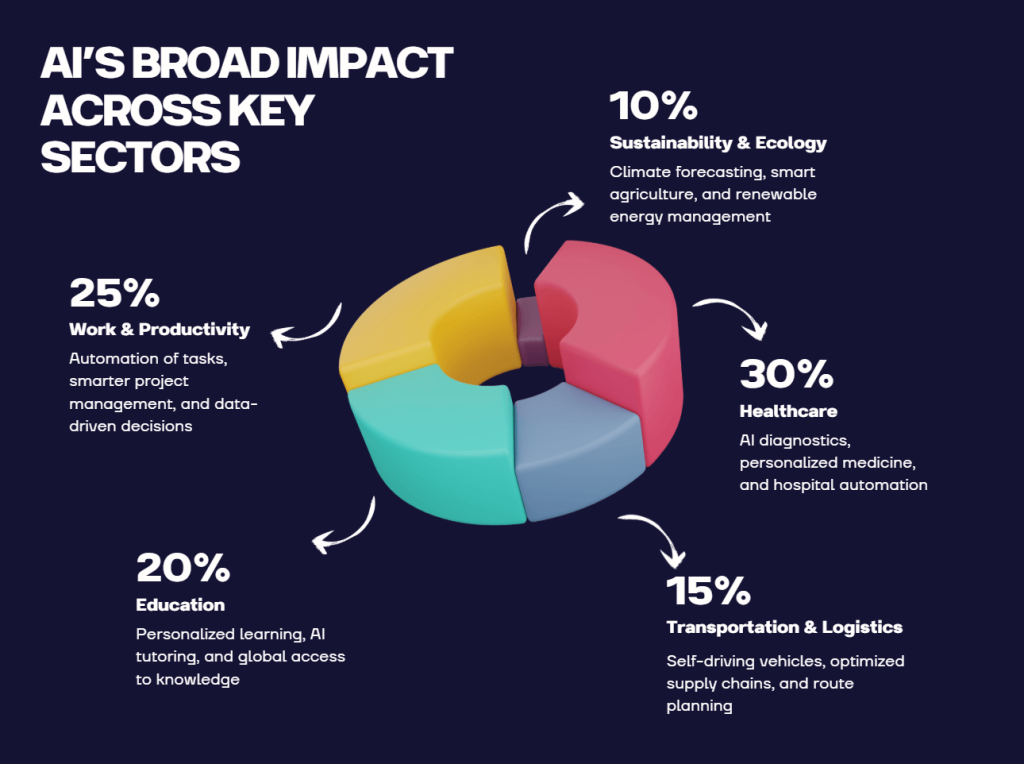
AI’s broad impact across key sectors infographic – 30% healthcare, 25% work and productivity, 20% education,15% transportation and logistics,10% sustainability and ecology

Conclusion

AI is not just about replacing jobs or improving products. It’s about reinventing industries, accelerating decision-making, and enabling sustainability at scale. From Google and Microsoft to Tesla and Amazon, the world’s largest companies are already leveraging AI to drive transformation.

FAQ: How Artificial Intelligence Is Reshaping Our World

1. How is AI improving healthcare?

AI enables faster diagnostics, personalized treatments, and streamlined hospital systems. DeepMind’s AI even outperforms radiologists in detecting breast cancer.

2. What role does AI play in personalized medicine?

AI analyzes patient DNA and medical history to create customized treatment plans, leading to more effective outcomes.

3. Will AI replace teachers?

No. AI supports educators by handling repetitive tasks, while teachers remain essential for creativity, guidance, and emotional connection.

4. How does AI increase workplace productivity?

AI automates repetitive tasks, enhances project management, and enables real-time data-driven decisions with tools like Microsoft Power BI.

5. What companies are using AI for decision-making?

Microsoft integrates AI in Power BI to deliver predictive insights, helping businesses make smarter, faster decisions.

6. How is AI applied in transportation and logistics?

AI powers self-driving cars, forecasts supply chain demand, and optimizes delivery routes to cut costs and emissions.

7. Which companies are leading autonomous vehicle innovation?

Tesla, Waymo (Alphabet), and Cruise (GM) are at the forefront of developing safer self-driving technologies.

8. Can AI reduce energy consumption?

Yes. Google’s AI reduced energy use in its data centers by up to 40%, showing how AI drives greener operations.

Related Reading

Ethan Rowland
Last updated: Apr 07, 2026
3 min read