Large language models power ChatGPT, Gemini, Claude, and the wave of AI tools that have reshaped how we write, code, and search. But what actually is a large language model, and how does it turn a prompt into a coherent answer? This plain-English guide explains what an LLM is, how it works, the jargon you'll encounter, and what these systems can — and can't — do.
What Is a Large Language Model?
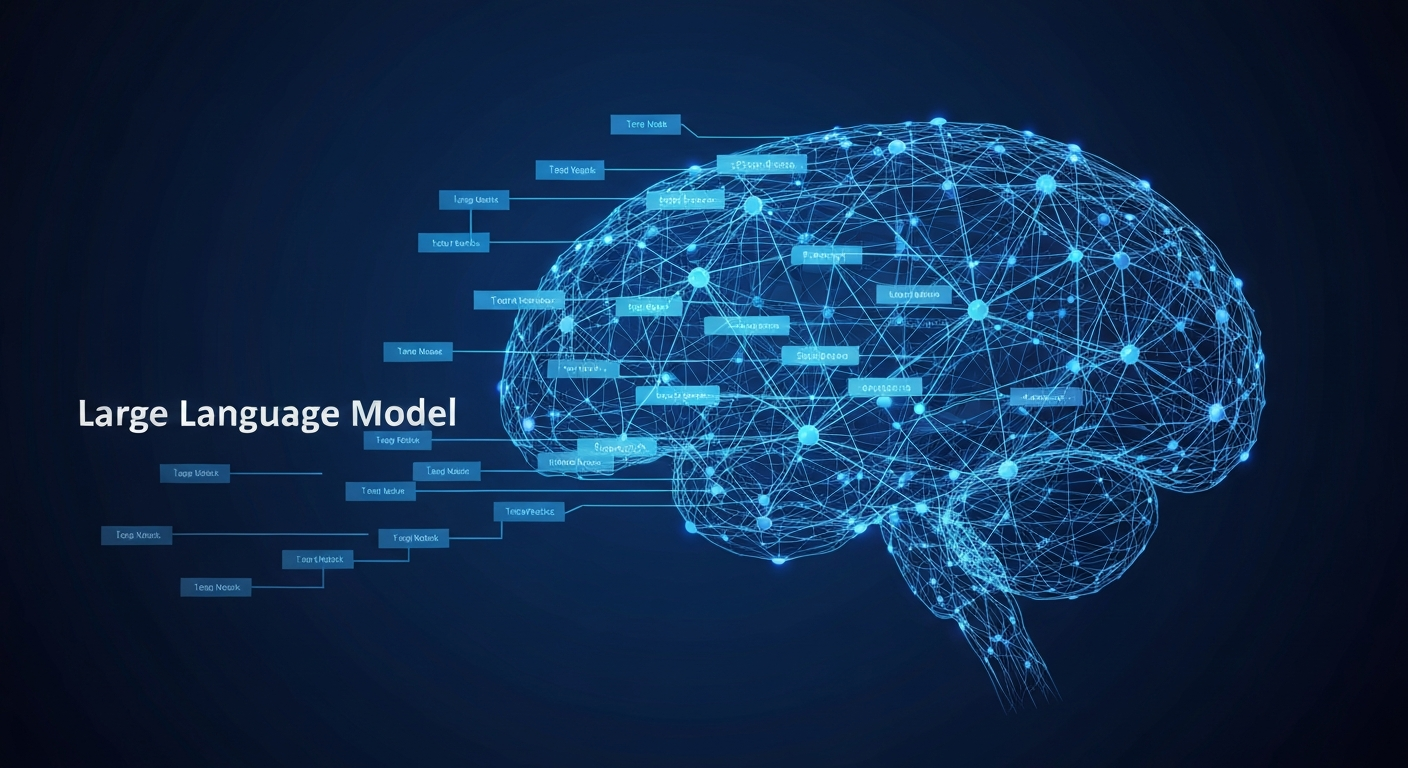
A large language model (LLM) is a type of artificial intelligence trained on enormous amounts of text to understand and generate human language. At its core, an LLM does one deceptively simple thing: it predicts the next word (or token) in a sequence, over and over, to produce sentences, paragraphs, and entire documents. The "large" refers to two things — the vast dataset it learns from and the billions of internal parameters it uses to make those predictions.
Despite feeling like it "understands" you, an LLM has no beliefs or awareness. It's a statistical pattern machine of remarkable scale, and that framing explains both its power and its flaws.
How Does an LLM Actually Work?
Three ideas explain most of what's going on under the hood:
1. Tokens
LLMs don't read words the way we do. They break text into tokens — small chunks that can be whole words, parts of words, or punctuation. "Unbelievable" might be split into "un," "believ," and "able." The model works entirely in tokens, both reading your prompt and generating its reply one token at a time.
2. The Transformer and Attention
Modern LLMs are built on the transformer architecture, introduced by Google researchers in 2017. Its breakthrough is a mechanism called attention, which lets the model weigh how relevant every word in the input is to every other word. That's how it keeps track of context — understanding that "it" refers to a specific noun three sentences back, for example.
3. Parameters
Parameters are the adjustable values the model tunes during training — essentially the "knowledge" it stores. Today's leading models have hundreds of billions of parameters. More parameters generally mean more capability, though efficiency and training quality matter just as much as raw size.
How LLMs Are Trained
Training happens in stages:
- Pre-training: the model reads a massive corpus of text — books, websites, code — and learns to predict missing or next tokens. This is where it absorbs grammar, facts, reasoning patterns, and style.
- Fine-tuning: the pre-trained model is refined on narrower, higher-quality data to make it better at following instructions.
- Reinforcement learning from human feedback (RLHF): humans rank the model's responses, and it learns to prefer answers people find helpful, accurate, and safe.
The result is a model that not only predicts plausible text but tends to produce useful, well-behaved responses.
Key LLM Terms at a Glance
| Term | What it means |
|---|---|
| Token | A chunk of text the model processes |
| Parameter | A tunable value storing learned patterns |
| Context window | How much text the model can consider at once |
| Prompt | The input you give the model |
| Hallucination | A confident but false or invented answer |
| Fine-tuning | Adapting a base model to a specific task |
What LLMs Are Good At — and Where They Fail
LLMs excel at language tasks: drafting and editing text, summarising, translation, answering questions, writing and debugging code, and brainstorming. But they have real limitations:
- Hallucinations: because they predict plausible text, they can state false information confidently. Always verify facts.
- Knowledge cutoffs: a model only knows what was in its training data unless connected to live tools or search.
- No true reasoning or understanding: they pattern-match extremely well, but they don't "know" things the way people do.
- Bias: they can reflect biases present in their training data.
Understanding these limits is the key to using LLMs well — they're powerful assistants, not oracles.
Where You'll Find LLMs
LLMs now sit behind chatbots and assistants, writing and content tools, coding copilots, customer-support systems, search engines, and countless niche AI products. Many are enhanced with retrieval-augmented generation (RAG), which feeds the model relevant documents at query time to improve accuracy and reduce hallucinations — a common approach for business and research tools.
LLMs vs Traditional AI
Older AI systems were typically built for one narrow task — a spam filter, say, or a recommendation engine. LLMs are general-purpose: the same model can write an email, explain a concept, and generate code, all from natural-language instructions. That flexibility is why they've spread so quickly across industries.
The Bottom Line
A large language model is an AI trained on vast text to predict language token by token, using the transformer architecture and billions of parameters to stay coherent and on-topic. It's extraordinarily capable at language tasks but prone to hallucinations and bound by its training data. Treat an LLM as a brilliant, fast, and occasionally unreliable assistant — verify its facts, give it clear prompts, and it becomes one of the most useful tools you can have.
Find the Right AI Tool for Your Workflow
From chatbots and writing assistants to coding copilots — our directory lists each AI tool with an evidence label.