What Is an AI Agent? A Plain-English Guide for 2026
An AI agent is software that can pursue a goal on its own — planning, using tools, and acting without step-by-step instructions. Here's how they actually work.
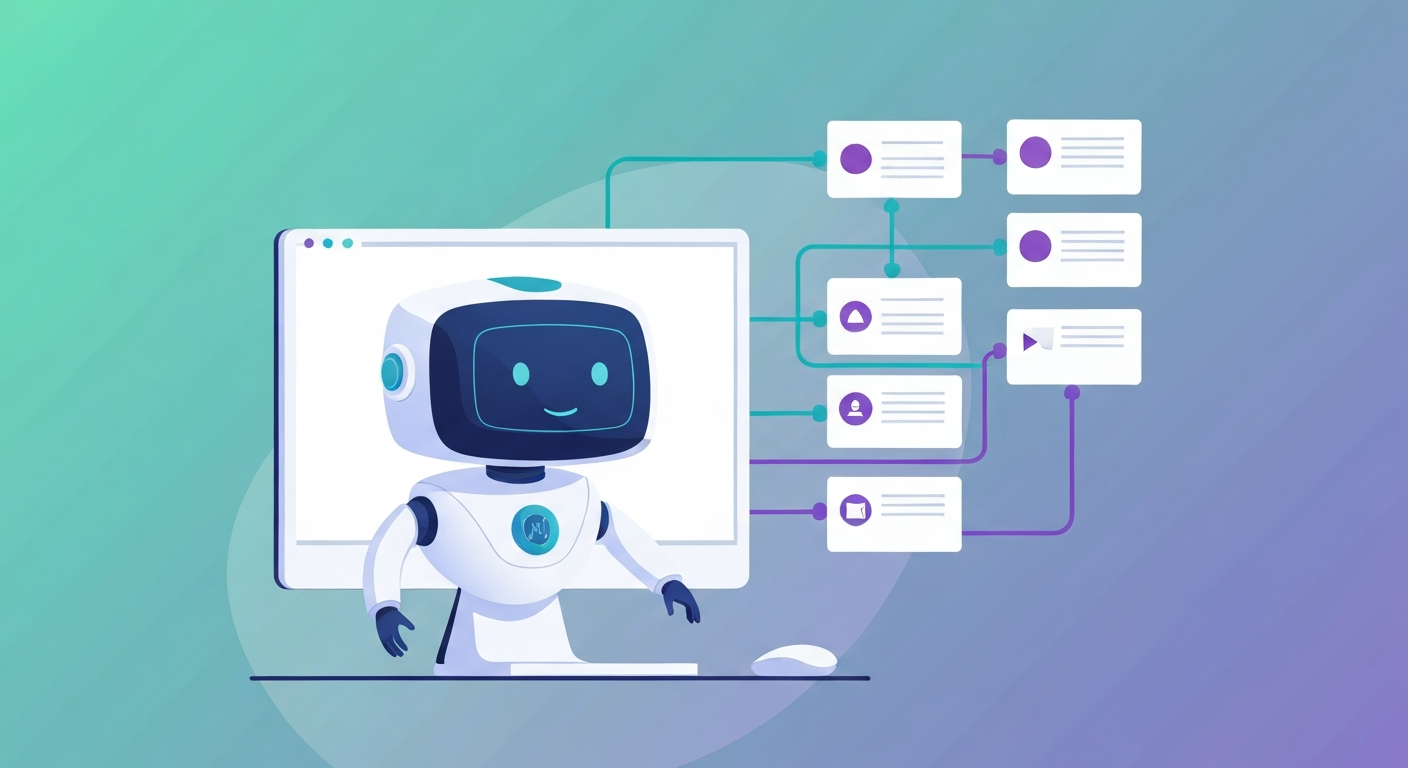
“AI agent” has become one of the most-used phrases in technology, but also one of the most slippery. Is it just a chatbot? A robot? A new kind of app? In plain English, an AI agent is software that can take a goal and figure out how to accomplish it on its own — planning the steps, using tools, and acting without being told exactly what to do at each stage. This guide explains what that really means, how agents work, and where they are useful today.
The simple definition
A traditional program does exactly what it is told: you click a button, it runs a fixed set of instructions. A chatbot responds to each message you send, one turn at a time. An AI agent goes a step further. You give it an objective — “find the three cheapest flights to Rome next month and put them in a spreadsheet” — and it works out the sequence of actions needed, carries them out, checks its own progress, and adjusts until the goal is met.
The defining quality is autonomy. An agent decides how to reach a goal rather than waiting for you to spell out every step. That single shift is what separates an agent from an ordinary chatbot or automation script.
How an AI agent actually works
Under the hood, most modern AI agents are built around a large language model (LLM) — the same kind of technology behind ChatGPT, Claude, or Gemini — wrapped in a loop that lets it think and act repeatedly. The typical cycle has four parts.
- Perception: the agent takes in a goal and any relevant context — your instructions, files, or live data.
- Planning: the model breaks the goal into smaller steps and decides what to do first.
- Action: it uses a tool — searching the web, running code, calling an API, editing a file — to carry out that step.
- Reflection: it looks at the result, judges whether it worked, and either continues, corrects course, or finishes.
This loop repeats until the objective is complete. The ability to call tools is crucial: it is what lets an agent do things in the real world rather than just produce text.
Agents vs chatbots vs automations
It helps to see the three side by side. A chatbot answers whatever you ask, but forgets the goal the moment the conversation moves on — it reacts. A classic automation follows a fixed, pre-defined path every time and cannot adapt if something unexpected happens. An AI agent sits in between and beyond both: it holds a goal in mind across many steps, and it improvises the path rather than following a script. Give a chatbot a complex task and it hands you instructions; give an agent the same task and it tries to complete it.
Real-world examples
Agents are already showing up in tools people use every day:
- Coding agents that read a bug report, explore the codebase, write a fix, run the tests, and open a pull request.
- Research agents that browse dozens of sources, cross-check facts, and produce a cited summary.
- Customer-support agents that look up an order, process a refund, and email the customer — not just suggest what to do.
- Personal-assistant agents that book travel, compare prices, and manage a calendar across multiple apps.
What these share is that the agent takes actions in external systems, not just conversation.
The building blocks
Beyond the core model, robust agents usually rely on a few extra components. Memory lets an agent remember earlier steps and past interactions so it does not lose the thread on long tasks. Tools and integrations connect it to the outside world — browsers, databases, email, code interpreters. And increasingly, multi-agent systems split a big job across several specialised agents that hand work to one another, much like a team of coworkers with different roles.
Where agents still fall short
Agents are powerful but far from flawless, and it pays to be realistic. Because they rely on LLMs, they can “hallucinate” — act confidently on wrong information. Long chains of steps can compound small errors into a bad final result. They can get stuck in loops, misuse a tool, or take an action you did not intend, which is why giving an agent real power demands guardrails and human oversight. For anything high-stakes, a “human in the loop” who approves key actions is still essential.
Should you use one?
If a task is repetitive, involves several tools, and has a clear goal you can describe, it is a strong candidate for an agent — think research, data gathering, routine coding, or multi-step admin. If a task is simple and one-shot, a plain chatbot or a fixed automation is often faster and more predictable. The art is matching the tool to the job rather than reaching for an agent because it is the trend.
The bottom line
An AI agent is software that pursues a goal on its own — perceiving, planning, using tools, and reflecting in a loop until the job is done. That autonomy is what makes agents genuinely new, powerful enough to complete real work but still error-prone enough to need supervision. As the models and their tools improve through 2026 and beyond, agents are moving from novelty to everyday infrastructure — and understanding what they are is the first step to using them well.
Find the right AI tools for the job
Agents are only as good as the tools they can reach. Explore our guides to AI software across writing, coding, images, and business.


