How Artificial Intelligence Is Reshaping the Job Market in 2026
A Disruption as Pervasive as the Early Internet Artificial Intelligence is disrupting the labor landscape much like the internet did in the 1990s. As websites a
Published September 17, 2025·Updated April 17, 2026
A Disruption as Pervasive as the Early Internet
Artificial Intelligence is disrupting the labor landscape much like the internet did in the 1990s. As websites and email transformed business processes, AI today automates tasks once considered too complex – especially in entry-level roles. Analysts project that up to 50% of beginner-level positions may be eliminated or reshaped; meanwhile, others argue AI will create as many jobs as it replaces.
Roles That Are Disappearing – and the AI Tools Replacing Them
Role
AI Tools
Impact
Customer Support Representatives
Chatbots like Ada, Forethought, Ultimate AI
Automates thousands of inquiries, reducing the need for human agents
Creates visuals and short videos, replacing basic creative tasks
Market Research Assistants
ChatGPT with browsing, Crayon AI, Quid
Collects and summarizes market data, reducing roles for analysts
Implications for the Workforce
Repetitive, execution-focused jobs – especially those at the entry level – are most at risk of automation. In contrast, roles requiring strategy, creativity, and emotional intelligence are becoming increasingly valuable. Firms once relying heavily on junior staff are transitioning toward smaller teams of skilled supervisors capable of guiding and optimizing AI systems.
Workforce Impact: Data and Projections for 2025
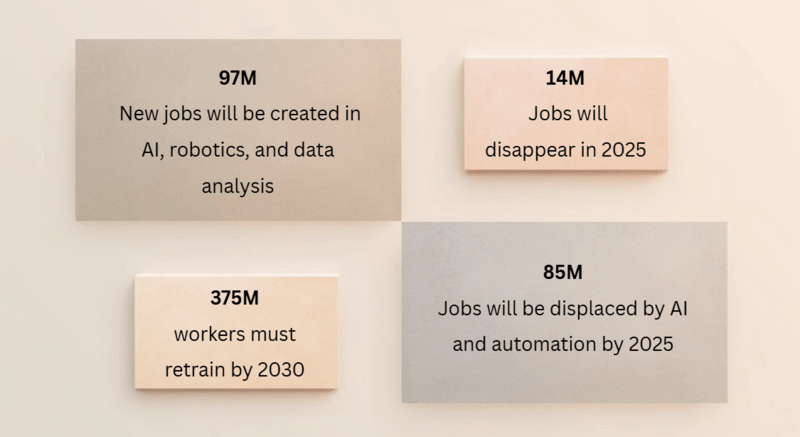
Global Workforce Impact: AI and automation are set to displace 85 million jobs globally by 2025, while simultaneously creating 97 million new jobs in AI, robotics, and data analysis.
Demand for Reskilling: An estimated375 million jobs (14% of the global workforce) will require reskilling by 2030.
Advanced Economies at Risk: Up to 60% of jobs in advanced economies may be exposed to AI automation, compared to just 26% in lower-income nations.
Acceleration of Skill Required: Skills demanded for AI-exposed roles are changing 66% faster than those in non-AI roles.
Immediate Displacement: In 2025, an estimated 14 million jobs worldwide and approximately 2.1 million U.S. jobs are expected to be displaced due to AI automation.
Emerging Career Opportunities: Workforce transformations include new roles such as AI trainers, ethicists, model supervisors, and technicians – especially as creative and human-centric skills become paramount.
What to Expect in 2026
Growing Demand for AI-Literate Skills: Employers will prioritize digital literacy, ethics, adaptability, and higher-order thinking more than ever.
Shift to Skill-Based Hiring: Résumés emphasizing AI-relevant skills may become more valued than traditional degrees.
More Sophisticated Role Evolution: Entry-level jobs may vanish – but mid- and high-skilled positions supported by AI will flourish (e.g., roles in AI oversight, governance, and creative collaboration).
Policy & Education Play Crucial Roles: Governments and educational systems will need to invest more in training programs, certification initiatives, and career transition support.
AI isn’t just about replacing jobs – it’s about redefining work. While 2026 brings rapid changes, the story isn’t one of decline – it’s about how humans reshape the future of work through collaboration with AI.
AI and Jobs in 2026: Key Questions Answered
1. How many jobs will AI displace by 2025?
Analysts project that AI and automation will displace around 85 million jobs globally by 2025.
2. Will AI create new jobs as well?
Yes. While many jobs will be displaced, AI is expected to create around 97 million new jobs, especially in fields like robotics, AI training, and data analysis.
3. Which jobs are most at risk from AI automation?
Repetitive, execution-focused roles – such as customer support, junior web development, and routine content writing – are most vulnerable to automation.
4. How many workers will need reskilling because of AI?
By 2030, an estimated 375 million workers (14% of the global workforce) will require reskilling to adapt to AI-driven changes.
5. Which economies are most exposed to AI automation?
Up to 60% of jobs in advanced economies may be exposed to AI automation, compared to 26% in lower-income nations.
6. How fast are skill requirements changing due to AI?
Skills demanded for AI-exposed roles are changing 66% faster than those in non-AI roles, creating pressure for continuous learning.
7. How can companies reduce workforce stress caused by AI?
Instead of layoffs, many companies focus on reskilling and retraining. For example, the U.S. Federal Reserve found that only 1% of service firms reported layoffs, while 34% retrained employees.
8. How should individuals prepare for the future of work with AI?
Focus on AI literacy, adaptability, creativity, and emotional intelligence. Employers are expected to prioritize these higher-order skills over traditional degrees.
The year is 2026, and the whispers about Artificial Intelligence transforming work have solidified into a resounding roar. A recent industry report from TechCrunch projects that by the end of 2026, over $200 billion will have been invested globally in AI technologies specifically aimed at workforce automation and augmentation, a 35% increase from 2025. This isn't just about robots on factory floors; it's about sophisticated algorithms permeating every cubicle and corner office, fundamentally reshaping the job market as we know it.
TL;DR: In 2026, AI is not just displacing jobs but primarily augmenting them, creating new roles, and demanding a significant upskilling of the global workforce. Companies are investing billions, and individuals must adapt by mastering AI tools and focusing on uniquely human skills like creativity and critical thinking to thrive.
The transition from a speculative "2025 forecast" to a "2026 reality" reveals a dual impact: a strategic displacement of routine tasks and an explosive creation of new roles centered around AI management, ethics, and integration. This article dives into the concrete shifts happening now, the companies leading the charge, and what you need to know to navigate the evolving professional landscape.
The Accelerating AI Impact on the Job Market in 2026
The narrative around AI and the job market has matured beyond simple job displacement. While automation certainly continues to streamline processes and absorb repetitive tasks, 2026 is truly the year of AI augmentation. Instead of outright replacing humans, AI is increasingly becoming a powerful co-pilot, enhancing productivity, enabling faster decision-making, and opening doors to previously impossible innovations.
Automation's Current Reach
Automation driven by AI is no longer limited to manufacturing. It's deeply embedded in administrative tasks, data entry, basic content generation, and even preliminary legal research. Large Language Models (LLMs) like OpenAI's GPT-4.5 (expected in late 2026) and Google's Gemini Ultra are powering enterprise solutions that can draft emails, summarize lengthy reports, and generate marketing copy with remarkable fluency. For instance, tools like Jasper AI are now standard in many marketing departments, automating up to 70% of initial content drafts, allowing human writers to focus on strategy and refinement.
Beyond text, visual AI tools are transforming creative industries. AI photo editors like Adobe Firefly and Midjourney V7 (released in early 2026) enable designers to generate complex images, manipulate photos, and create entire visual campaigns in a fraction of the time. Similarly, AI video tools are democratizing video production, allowing small businesses to create high-quality promotional content without extensive budgets or specialized teams.
The Augmentation Revolution
The real story of 2026 is how AI is making human workers more efficient and effective. Developers are using AI coding assistants like GitHub Copilot Enterprise ($39/user/month) and Amazon CodeWhisperer, which write code suggestions, debug, and even generate entire functions. This doesn't eliminate the need for developers but shifts their focus to higher-level architecture, complex problem-solving, and innovative feature development.
Similarly, sales teams are leveraging AI for lead scoring and personalized outreach, while HR departments use it for resume screening and candidate matching. The goal isn't to remove the human element but to offload the mundane, data-heavy, or repetitive tasks, freeing up human talent for strategic thinking, creative problem-solving, and interpersonal engagement.
Roles Undergoing Significant Transformation
While some roles are seeing significant automation, others are evolving into AI-augmented versions, requiring new skill sets and a different approach to work.
Customer Service & Support
The traditional call center agent role is rapidly evolving. AI-powered chatbots and virtual assistants now handle upwards of 80% of routine customer inquiries for major companies like Verizon and Delta Airlines. This has led to a reduction in entry-level customer service positions focused solely on basic query resolution. However, it has simultaneously created demand for:
AI Chatbot Trainers/Optimizers: Professionals who fine-tune AI responses, analyze user interactions, and improve bot performance.
Complex Issue Specialists: Human agents who handle escalated problems, emotional customers, and situations requiring empathy and nuanced judgment that AI currently lacks.
Content Creation & Marketing
This sector has been one of the earliest adopters of generative AI. While tools like Jasper AI, Copy.ai, and ChatGPT can generate blog posts, social media updates, and product descriptions, the demand for human creativity, strategic thinking, and brand voice remains paramount. The shift is from pure content generation to content strategy, AI prompt engineering, and editing/refining AI outputs.
Visual content roles are also changing. AI headshot generators and AI photo editors are commonplace, reducing the need for basic photo manipulation or even some professional photography sessions for standard corporate imagery. Graphic designers now spend less time on repetitive tasks and more on conceptual design, brand development, and art direction, often using AI as a powerful ideation and execution assistant.
Automates data collection, summarization, trend spotting
AI Data Analyst, Strategic Insights Manager
ChatGPT with browsing, Crayon AI, Quid, Synthesia AI
Software Development & IT
The IT sector is witnessing a profound transformation. While AI coding assistants are ubiquitous, they are not eliminating developers. Instead, they are elevating the role, allowing engineers to tackle more complex architectural challenges, focus on system design, and innovate faster. The demand for AI engineers, machine learning specialists, and data scientists continues to surge, often commanding six-figure salaries. Cloud service providers like AWS, Azure, and Google Cloud are seeing massive demand for AI integration experts, with salaries for senior roles often exceeding $200,000 annually.
Data Analysis & Research
AI's ability to process and synthesize vast datasets in seconds has significantly impacted entry-level data analysis. Tools can now identify trends, generate reports, and even predict outcomes with high accuracy. This means human analysts are shifting from data crunching to interpreting AI-generated insights, developing complex models, and communicating data stories. The focus is now on critical thinking and strategic application of data rather than raw data manipulation.
The Rise of New AI-Driven Opportunities
The narrative isn't just about jobs lost; it's also about a vibrant ecosystem of new roles emerging. These positions often require a blend of technical understanding and uniquely human skills.
Emerging Job Categories
Prompt Engineers: Experts in crafting precise queries for generative AI models to achieve desired outputs. Companies like Anthropic and Google are actively hiring prompt engineers, with salaries ranging from $100,000 to $300,000.
AI Ethicists and Governance Specialists: Professionals ensuring AI development and deployment are fair, unbiased, and compliant with evolving regulations (e.g., the EU AI Act).
AI Integration Specialists: Experts who bridge the gap between AI tools and existing business systems, ensuring seamless adoption and maximizing ROI. This often involves using best AI business tools and custom API integrations.
AI Trainers and Annotators: Human workers who label data, provide feedback, and refine AI models to improve their performance and accuracy.
AI UX/UI Designers: Designing intuitive interfaces for AI-powered applications, focusing on user interaction with intelligent systems.
High-Value Human Skills
As AI handles more cognitive tasks, the value of uniquely human attributes skyrockets. These "soft skills" are becoming the hardest to automate and the most crucial for career longevity:
Creativity and Innovation: Generating novel ideas, problem-solving in unprecedented situations.
Critical Thinking and Complex Problem-Solving: Analyzing AI outputs, questioning assumptions, and tackling multi-faceted challenges.
Emotional Intelligence: Understanding and managing emotions, crucial for leadership, negotiation, and customer relations.
Adaptability and Lifelong Learning: The ability to continuously learn new tools, technologies, and methodologies.
Interpersonal Communication: Effectively collaborating with diverse teams and communicating complex ideas.
Economic Shifts and Corporate Investment in AI
The financial world is pouring unprecedented resources into AI, signaling a long-term commitment to its integration across all industries. Venture capital funding for AI startups hit an all-time high in Q1 2026, with over $35 billion invested globally, marking a 20% increase year-over-year.
Major Tech Players Leading the Charge
Tech giants are not just developing AI; they're integrating it deep into their core offerings, often with premium pricing models:
Microsoft: Their Copilot suite, integrated into Microsoft 365, is a prime example. Priced at $30 per user per month for enterprise customers, it's projected to generate billions in revenue by 2027, demonstrating the value businesses place on AI-augmented productivity.
Google: With its Gemini models, Google is embedding AI across its Workspace suite, Android, and search capabilities. The ongoing competition between ChatGPT vs. Gemini continues to drive innovation and adoption in the generative AI space.
Adobe: Firefly, their generative AI suite, is now integral to Creative Cloud, allowing designers to generate images and manipulate existing assets at unprecedented speeds.
Salesforce: Salesforce Einstein Copilot, an AI assistant for CRM, is transforming sales, service, and marketing operations, offering personalized customer experiences and automating routine tasks.
Startup Ecosystem and Venture Capital
Beyond the giants, a thriving startup ecosystem is capitalizing on niche AI applications. Companies specializing in everything from AI website builders to specific industry automation tools are attracting significant investment. This proliferation means more accessible and affordable AI solutions for businesses of all sizes, often found through resources like an AI tool finder or by using an AI cost calculator to compare options.
This investment surge underscores the belief that AI is not a fleeting trend but a fundamental shift in how businesses operate and how value is created in the economy.
What This Means for Your Career in 2026
Understanding the broader trends is one thing; applying them to your personal career path is another. Here's a breakdown for various roles:
For Content Creators & Marketers
Your role is shifting from pure creation to strategic oversight and refinement. Tools like Jasper AI and Copy.ai are your new assistants. Focus on:
Mastering Prompt Engineering: Learn to guide AI to produce high-quality, on-brand content.
Brand Voice & Tone: Ensure AI-generated content aligns perfectly with your brand's unique identity.
Ethical AI Use: Understand plagiarism, bias, and responsible AI content generation.
For Developers & IT Professionals
AI is your co-pilot, not your replacement. Leverage AI coding assistants to increase your output and focus on:
AI Frameworks & Libraries: Become proficient in TensorFlow, PyTorch, and other ML frameworks.
Cloud AI Services: Expertise in AWS Sagemaker, Azure ML, Google AI Platform.
API Integration: Seamlessly connect AI services with existing systems.
Security & Ethics: Understand the vulnerabilities and ethical considerations of AI systems.
For Small Business Owners
AI offers unprecedented opportunities for efficiency and growth without massive overhead. Explore best AI business tools to:
Automate Marketing: Use AI for social media management, email campaigns, and ad optimization.
Streamline Operations: AI for customer service, inventory management, and data analysis.
Boost Productivity: Utilize AI writing assistants for proposals, AI website builders for quick online presence, and AI schedulers.
Identify Opportunities: Use AI to analyze market trends and customer behavior. Don't hesitate to use an AI tool finder to discover solutions tailored to your needs or compare AI tools side-by-side.
For Customer Service Professionals
Your role is shifting towards high-value interactions. Focus on:
Emotional Intelligence: Handle complex, sensitive, or emotionally charged customer interactions.
Problem-Solving: Tackle issues that AI cannot resolve, requiring creative solutions and critical thinking.
AI System Oversight: Manage and train AI chatbots, ensuring they provide accurate and helpful responses.
Product Expertise: Become an expert on your company's offerings to provide deep, personalized support.
What to Watch in Late 2026 and Beyond
The pace of AI innovation shows no signs of slowing down. As we move towards the latter half of 2026, several key areas will shape the next phase of AI's impact on the job market.
Advanced AI Models & Multimodality
Expect even more powerful and versatile AI models. The anticipated release of GPT-5, Llama 4, or similar next-generation models will push the boundaries of what AI can understand and generate, particularly in multimodal contexts (combining text, image, audio, and video seamlessly). This will lead to more sophisticated automation and augmentation capabilities across industries.
Regulatory Frameworks
Governments worldwide are grappling with how to regulate AI. The EU AI Act, expected to be fully implemented by late 2026 or early 2027, will set a global precedent for AI governance, focusing on safety, transparency, and fundamental rights. Similar efforts in the US and Asia will impact how companies develop and deploy AI, potentially introducing new compliance roles and influencing job security measures.
The "AI Literacy" Imperative
The demand for AI literacy—the ability to understand, use, and critically evaluate AI—will become universal. Educational institutions and corporate training programs will increasingly focus on equipping the workforce with these essential skills. Those who proactively invest in learning about AI tools and their applications will have a distinct advantage in the evolving job market.
Human-AI Collaboration Best Practices
As AI becomes more integrated, companies will focus on developing best practices for human-AI collaboration. This includes defining clear roles, establishing efficient workflows, and fostering a culture where AI is seen as an enabler rather than a threat. Research into cognitive load, trust in AI, and effective human oversight will be critical.
Frequently Asked Questions
Is AI going to take all our jobs?
No, not all jobs. While AI will automate many routine and repetitive tasks, it is simultaneously creating new jobs and augmenting existing ones. The consensus in 2026 is that AI will transform jobs rather than simply eliminate them, shifting human effort towards tasks requiring creativity, critical thinking, emotional intelligence, and strategic oversight.
What skills should I focus on to stay relevant in the AI era?
Focus on uniquely human skills such as creativity, critical thinking, complex problem-solving, emotional intelligence, and interpersonal communication. Additionally, developing "AI literacy" – understanding how to use, prompt, and manage AI tools effectively – is crucial. Continuous learning and adaptability are paramount.
How can small businesses leverage AI without massive investment?
Small businesses can leverage affordable, off-the-shelf AI tools for specific functions like marketing automation, customer service chatbots, content generation, and data analysis. Many AI business tools offer free tiers or low-cost subscriptions. Using an AI tool finder or an AI cost calculator can help identify cost-effective solutions tailored to specific needs.
Are entry-level jobs disappearing completely due to AI?
Entry-level jobs focused on highly repetitive or data-driven tasks are the most vulnerable to automation. However, new entry-level roles are emerging in areas like AI data annotation, prompt engineering, and AI tool support. The nature of entry-level work is evolving, requiring a foundational understanding of AI tools and a greater emphasis on learning and adapting.
What's the difference between AI automation and AI augmentation?
AI automation refers to AI systems performing tasks or entire processes independently, often replacing human effort (e.g., a chatbot handling customer inquiries). AI augmentation refers to AI systems enhancing human capabilities, making workers more efficient, productive, or capable (e.g., an AI coding assistant helping a developer write code faster). In 2026, AI augmentation is the dominant trend across most professional roles.
How quickly are these changes happening in the job market?
The changes are happening at an unprecedented pace. While broad shifts take years, specific AI tool adoption and task automation can occur within months. Companies are rapidly integrating AI, and the demand for new skills is accelerating, making continuous learning and adaptation essential for staying competitive in the 2026 job market and beyond.