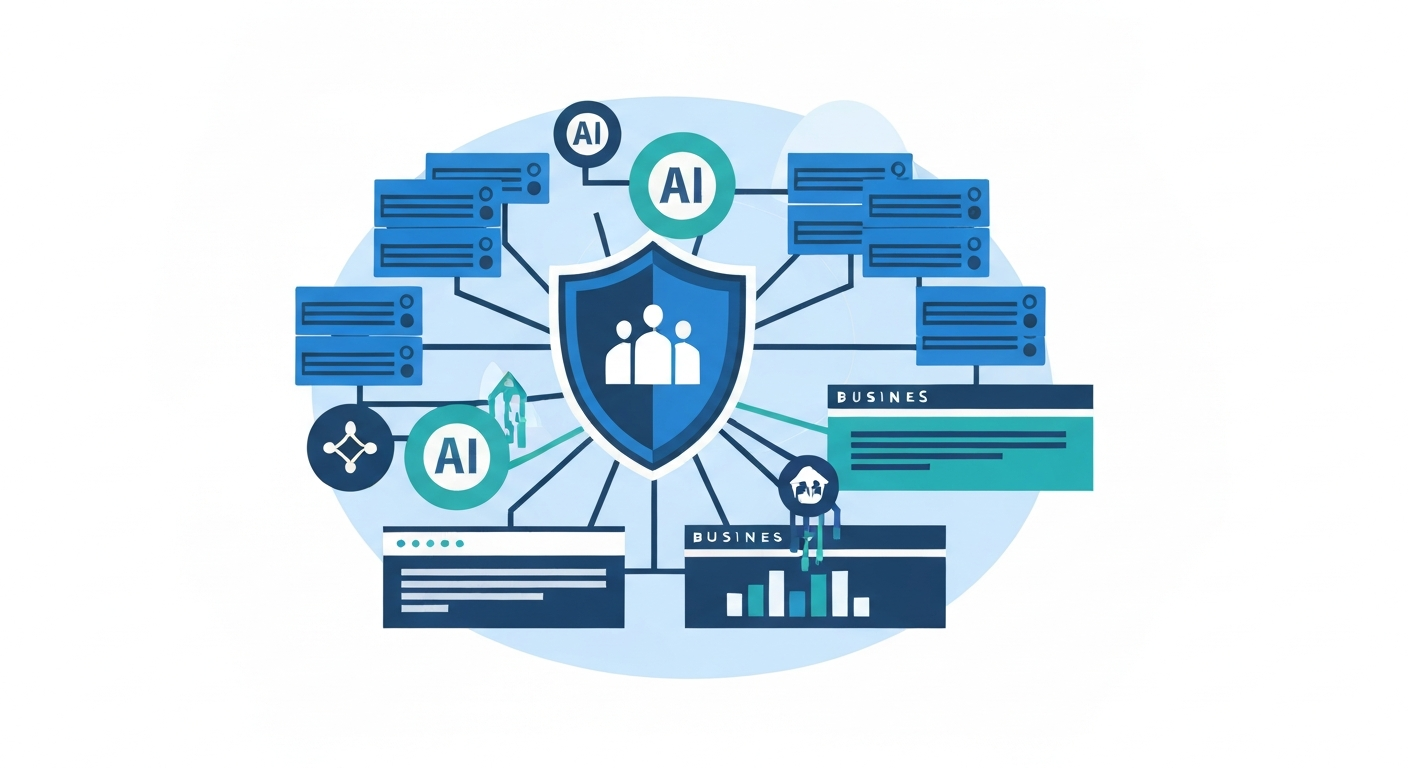
Enterprise AI software applies machine learning and generative AI to real business problems — securely, at scale, and grounded in your own data. This guide explains what to look for and ranks the leading enterprise AI platforms for 2026 for IT leaders and CTOs.
What Is Enterprise AI Software?
Enterprise AI software is a class of AI solutions built for large organizations. Unlike consumer tools, these platforms emphasize robust security, deep integration with existing IT systems, scalability for vast datasets, and strict governance and compliance. They provide tools to develop, deploy, and manage AI models across business functions — from automating tasks and analyzing data to powering decision support and customer experiences.
Key differences from consumer AI (like a standalone chatbot — see our primer on what a large language model is):
- Context & data sensitivity: runs on proprietary, sensitive data with strict access controls.
- Security & governance: compliance frameworks (GDPR, HIPAA), auditability, model governance.
- Integration: connects to ERP, CRM, data warehouses and other core systems.
- Scale & performance: handles industrial data volumes and many concurrent applications.
- Customization & control: tailored to industry verticals with more infrastructure control.
How to Choose an Enterprise AI Platform
- Data integration & connectors — secure, performant ingestion from your data sources and apps.
- Security & governance — RBAC, encryption, audit logging, and regulatory compliance.
- Scalability — scales with data volume, users, and expanding AI initiatives.
- Time-to-value — AutoML, pre-built solutions, and intuitive tooling that speed delivery.
- Agentic & automation capability — orchestration and autonomous multi-step workflows.
- RAG & grounding — retrieval from internal knowledge to cut hallucinations.
- Total cost of ownership — licensing, infrastructure, maintenance, and training.
- Support & ecosystem — vendor support, docs, and partner network.
Best Enterprise AI Software in 2026 (Comparison)
| Platform | Best for | Deployment |
|---|---|---|
| C3 AI | Industry-specific AI apps, data harmonization | Cloud / Hybrid / On-prem |
| Glean | Enterprise search, knowledge discovery | Cloud |
| Microsoft Azure AI (Foundry) | Broad cloud AI + MLOps, Microsoft ecosystem | Cloud / Hybrid |
| Google Vertex AI | Unified MLOps, model choice, responsible AI | Cloud |
| IBM watsonx | Foundation models + data governance | Cloud / Hybrid / On-prem |
| Moveworks | Conversational AI for IT/HR support | Cloud |
| DataRobot | AutoML and full-lifecycle MLOps | Cloud / Hybrid / On-prem |
| NVIDIA AI Enterprise | GPU-accelerated AI dev & inference | On-prem / Cloud |
| Palantir AIP | Operational AI, complex data integration | Cloud / Hybrid / On-prem |
| Amazon Bedrock | Managed foundation models for genAI apps | Cloud |
C3 AI
A model-driven platform for building and operating large-scale AI applications, with strong data integration and pre-built, industry-specific solutions. Best for: large-scale, industry-specific enterprise AI.
Pros: strong data integration/abstraction; pre-built industry apps; simplified maintenance. Cons: significant implementation investment; proprietary architecture (lock-in); best for complex, large-scale needs.
Glean
AI-powered enterprise search and knowledge discovery that connects company apps into a unified knowledge graph and answers questions in natural language. Best for: unified search and employee productivity.
Pros: consolidates info across apps; intuitive; time savings. Cons: search-focused, not a full dev platform; depends on data quality; limited custom MLOps.
Microsoft Azure AI (Foundry)
A broad ecosystem of AI services, MLOps, and responsible-AI tooling with deep integration across Microsoft and Azure. Best for: Microsoft-invested orgs wanting end-to-end cloud AI.
Pros: huge service portfolio; tight Microsoft integration; strong MLOps/security. Cons: breadth adds complexity; cost management needed; best on Azure.
Google Vertex AI
A unified ML platform covering the full lifecycle — data, training, deployment, monitoring — with wide model choice and responsible-AI governance. Best for: unified MLOps with strong governance.
Pros: single lifecycle platform; broad model selection; responsible-AI tooling. Cons: learning curve; cost complexity at scale; best within Google Cloud.
IBM watsonx
An enterprise AI and data platform spanning watsonx.ai (models), watsonx.data (AI-optimized store), and watsonx.governance. Best for: foundation models with strong governance in regulated industries.
Pros: governance, trust, explainability; curated models; hybrid-cloud ready. Cons: still evolving; smoother with existing IBM stack; some use-case-specific tooling.
Moveworks
Conversational AI for internal IT/HR support that automates common employee requests and integrates with tools like ServiceNow, Workday, and Teams. Best for: IT/HR self-service automation.
Pros: strong request automation; better employee experience; good integrations. Cons: narrow scope (internal support); needs tuning to org knowledge; value tied to ticket volume.
DataRobot
An AutoML and MLOps platform that automates model selection, tuning, deployment, and monitoring for data scientists and business users alike. Best for: accelerating ML with AutoML.
Pros: automates the ML lifecycle; accessible to varied skill levels; solid MLOps. Cons: advanced users may want more manual control; needs good data; sizable investment.
NVIDIA AI Enterprise
A cloud-native suite of optimized AI frameworks, pre-trained models, and tools for GPU-accelerated development, training, and inference. Best for: high-performance, GPU-accelerated AI.
Pros: GPU-optimized performance; comprehensive tooling; flexible deployment. Cons: requires NVIDIA GPU investment; best for compute-intensive needs; GPU learning curve.
Palantir AIP
An operational AI platform that integrates complex data and connects AI models/agents to real-world workflows and decisions. Best for: operational decision intelligence on complex data.
Pros: excellent data integration; operational AI that drives actions; strong governance. Cons: high complexity/cost; often needs consulting; overkill for simple use cases.
Amazon Bedrock
A fully managed service offering multiple foundation models through one API, with customization, RAG, and enterprise security for building genAI apps. Best for: fast genAI app development with model choice.
Pros: managed FMs; diverse model selection; strong security/privacy. Cons: less control over model internals; genAI-focused (not full MLOps); best on AWS.
Enterprise AI Trends to Watch in 2026
- Agentic AI & automation: systems that autonomously plan and execute multi-step tasks across enterprise apps.
- Governance & responsible AI: privacy, explainability, and bias controls becoming non-negotiable.
- Advanced RAG grounding: more reliable retrieval and citation of proprietary knowledge.
- On-prem & sovereign AI: rising demand for private/sovereign deployments in regulated sectors.
Frequently Asked Questions
What is enterprise AI software?
Specialized AI platforms built for organizational use — emphasizing data integration, security and governance, scalability, and compliance — to automate processes, surface insights from proprietary data, and support decision-making across departments.
How is it different from consumer tools like ChatGPT?
Enterprise AI handles proprietary data with strict privacy controls, integrates with core systems (CRM/ERP), meets regulatory compliance, and scales to corporate data loads — prioritizing accuracy, reliability, and auditability over broad public appeal.
Is enterprise AI software secure?
Security is foundational: encryption in transit and at rest, role-based access control, audit trails, and secure deployment, typically aligned to standards and regulations like GDPR, HIPAA, and CCPA.
Should we build or buy?
Buying speeds time-to-value and reduces upfront cost; building maximizes flexibility but needs in-house expertise. Most enterprises take a hybrid path — a commercial platform for foundations, custom models where differentiation demands it. For lighter needs, see our best AI business tools guide.
Bottom line: The 2026 enterprise AI market is deep, and the right platform depends on your data integration, security, scale, and time-to-value priorities. Match the shortlist above to your requirements before committing.