MAGI-2 on Higgsfield: What It Is, Pricing, How to Try It, and How It Compares to Seedance 2.5 and Kling (Nov 2026)
What MAGI-2 is, official Higgsfield pricing and specs, open-weights status, and how it compares with Seedance 2.5 and Kling. Checked 25 Nov 2026.
Affiliate disclosure: Some links on this page are affiliate links. Top10AI may earn a commission if you sign up through them, at no extra cost to you. Only the “try” links for Higgsfield, Kling and InVideo are partner links. Every link to Sand.ai, Higgsfield’s official documentation, ByteDance Seed, Kling official documentation and other vendor pages is a plain link. See how we rate for the editorial policy.
MAGI-2 is Sand.ai’s flagship video generation model, launched on 24 November 2026. Higgsfield’s product page says it is available now, only on Higgsfield. Official pages say it generates up to 30 seconds of native 1080p video with synchronized audio, from a text prompt plus optional image, video or audio references. This is a plain explainer, checked 25 Nov 2026, covering what MAGI-2 is, what official pages say it can do, how to try it on Higgsfield, what those pages say it costs, the open-weights status, and how the published specs compare with Seedance 2.5 and Kling.
Every plan, price and feature below comes from the vendor’s own pages on that date, linked where we use them. Top10AI did not generate clips or run its own tests for this article, and there are no scores, badges or star ratings here. Figures that appear on Higgsfield’s Video Arena or in Sand.ai’s own evaluations are quoted as those companies published them, not as Top10AI results. If you want a Higgsfield platform overview rather than this model guide, see our Higgsfield AI review. For Seedance 2.5, see our Seedance 2.5 explainer. For a wider shortlist, see Best AI video generator.
What is MAGI-2?
Sand.ai’s MAGI-2 research post, dated 24 November 2026, describes MAGI-2 as the lab’s full-scale flagship video model: a Multi-Head Latent mixture-of-experts system with 480 billion total parameters and about 28 billion active parameters, trained on roughly 4 trillion tokens. The same post says MAGI-2 generates up to 30 seconds of 1080p, 25 fps native audio-video, supports omni-reference across images, video and audio, and includes precision timeline control and video editing.
Higgsfield’s MAGI-2 product page introduces it as Sand.ai’s 480B-parameter AI video model, available on Higgsfield, and repeats the “available now, only on Higgsfield” claim. Sand.ai’s homepage likewise frames MAGI-2 as a model that can generate up to 30 seconds of native 1080p audio-video in a single pass, with multimodal referencing, precise editing and camera planning.
This flagship release is separate from MAGI-2 Preview, a smaller research release Sand.ai dated 5 August 2026 (about 114 billion total parameters and about 6 billion active, according to the 24 November flagship post). The numbers and features below refer to the November 2026 flagship model unless a sentence says otherwise.
Quick facts (from official pages, checked 25 Nov 2026):
- Maker: Sand.ai. Hosted today on Higgsfield, which calls the launch a Higgsfield exclusive (Sand.ai blog, 24 Nov 2026; Higgsfield MAGI-2 page).
- Announced: 24 November 2026, on Sand.ai’s blog and Higgsfield’s product and announcement pages.
- What it generates: Video and synchronized audio together, including lip-synced dialogue, sound effects, ambient sound and music, according to both official pages.
- Length and format: 4 to 30 seconds, 1080p, 25 frames per second, in six aspect ratios: 21:9, 16:9, 4:3, 1:1, 3:4 and 9:16 (Higgsfield FAQ; Higgsfield text-to-video API reference).
- Published size: Sand.ai’s blog and Higgsfield’s product page both say 480 billion total parameters, with about 28 billion active. Higgsfield’s announcement post instead describes MAGI-2 as a 400 billion parameter mixture-of-experts model, also with about 28 billion active, in the context of forthcoming open weights. We are quoting both published figures rather than choosing one.
- Where to try it: Higgsfield’s product page says “Available now, only on Higgsfield,” including the Higgsfield API. Official how-to and API links are below. Top10AI has not independently confirmed a generally available consumer app on Sand.ai’s own platform.
- Open weights: Not released as of 25 Nov 2026. Sand.ai says it will open-source MAGI-2 and publish a technical report; Higgsfield says open weights are “coming soon.” No date or license is named on those pages.
What MAGI-2 can do: inputs, length, resolution and shot control
The capabilities below are taken from Sand.ai’s 24 November blog, Higgsfield’s MAGI-2 product page and Higgsfield’s API references, all checked on 25 Nov 2026. They are vendor specifications, not results from a Top10AI test.
Inputs
Higgsfield’s FAQ says MAGI-2 generates video and sound from a text prompt, and can be guided further with image, video or audio references, or with start and end frames. A single generation can take up to 10 images, 5 videos and 5 audio clips (20 media items in total, which matches Sand.ai’s “up to 20 media items per native request”). Higgsfield says images can define how a character looks, video clips can show how something should move, and audio can set the sound.
The Higgsfield API exposes three MAGI-2 modes, all at the same published API price:
- Text to video — a prompt, a duration from 4 to 30 seconds, and an aspect ratio. Audio generation defaults to on.
- Image to video — a required first-frame image, an optional last-frame image, and an optional prompt.
- Reference to video — image, video and audio references, up to the 10 / 5 / 5 limits above.
The API reference also lists media limits for references: public HTTPS URLs; images under 30 MB; videos as MP4 or MOV, up to 200 MB and 2 to 30 seconds each; audio as WAV or MP3, up to 15 MB and 2 to 30 seconds each; and a cap of 30 seconds on total reference video duration and on total reference audio duration.
Length, resolution and aspect ratio
Official pages agree on a 4 to 30 second window, native 1080p, and 25 frames per second. The Higgsfield text-to-video API lists 1080p as the only resolution option, and lists six aspect ratios: 21:9, 16:9, 4:3, 1:1, 3:4 and 9:16, with 16:9 as the default and 5 seconds as the default duration.
Shot control, editing and audio
Higgsfield’s FAQ says framing, camera movement, timing and cuts can all be described in the prompt, and offers this consistency tip: keep each clip to one or two actions and a single camera move. Sand.ai’s blog describes the same area as “precision timeline and shot-cut control.”
Targeted editing of existing footage is also listed. Higgsfield’s example is to upload a source clip and describe the change, for instance: “Change the jacket from red to navy and keep the original camera movement.”
Audio is generated with the video: lip-synced dialogue, sound effects, ambient sound and music, according to the Higgsfield FAQ and Sand.ai’s blog. For a silent clip, Higgsfield says to turn off the Sound toggle before generating. The API exposes the same choice as a generate_audio flag that defaults to true, and says generated audio is included in the published API price.
Sand.ai’s own 24 November post also lists limitations it has not fully solved: extreme high-speed motion can occasionally produce trajectory or continuity artifacts; medium- and wide-shot 2D animation can appear overly smooth in fine local motion; and complex soundscapes still have room for richer layering and physical realism. Those are Sand.ai’s caveats, not Top10AI findings.
How to try MAGI-2 on Higgsfield, step by step
The steps below follow Higgsfield’s official MAGI-2 page and FAQ, plus the public API references. They are not a hands-on walkthrough of a Top10AI account, and button labels may change; confirm them on the live Higgsfield page.
- Open MAGI-2 on Higgsfield. Higgsfield’s product page says the model is available now, only on Higgsfield. Use the partner link below, or go to Higgsfield’s own MAGI-2 page and follow its “Try MAGI-2” call to action. Developers can use the Higgsfield API instead.
- Start with a text prompt. Official pages say MAGI-2 generates video and sound from a text prompt. The API documents a maximum prompt length of 15,000 characters.
- Add references if you have them. You can include up to 10 images, 5 videos and 5 audio clips in a single request, according to Higgsfield and Sand.ai.
- Optionally set a first and last frame. Higgsfield’s FAQ says you can choose an image as the start frame and an end frame to decide where the clip finishes. The image-to-video API treats the first frame as required and the last frame as optional.
- Choose duration and aspect ratio. Duration is 4 to 30 seconds. Aspect ratio is one of the six options listed above. Output is 1080p at 25 fps on the official pages.
- Decide whether you want sound. Sound is generated with the video by default. Higgsfield’s FAQ says to turn off the Sound toggle for a silent clip.
- Describe camera moves and cuts in the prompt if you need them. Higgsfield’s stated tip is to keep each clip to one or two actions and a single camera move.
- To edit existing footage, Higgsfield says to upload the source clip and describe the change, rather than regenerating from scratch.
- Watch concurrency limits. Higgsfield’s FAQ says that, depending on your plan, MAGI-2 runs from one to four generations at a time, with more parallel generations on the Enterprise plan. The API reference is stricter on the API itself: one generation at a time per account across all three MAGI-2 modes, with extra requests waiting in the queue, unless you contact sales to raise the limit.
Pricing: what official pages show (checked 25 Nov 2026)
Prices and credit rates change. Confirm them on the live Higgsfield pricing page and API reference before you budget a project. The figures below are what official pages showed on 25 Nov 2026 (Asia/Nicosia). Top10AI has not measured actual billed totals, retries or failed takes.
Higgsfield app: credits
Higgsfield’s MAGI-2 announcement states a rate of 2.5 credits per second for MAGI-2. The company’s US pricing page (last updated 25 Nov 2026) lists plan prices and monthly credit allowances, but it does not itself repeat that MAGI-2 per-second credit rate, so the 2.5-credit figure is cited from the announcement post.
From that published 2.5 credits-per-second rate, a 5-second clip would be 12.5 credits and a 30-second clip would be 75 credits. Those two totals are arithmetic from Higgsfield’s stated rate, not a separately posted list price.
The same pricing page lists these US individual plans, and notes that prices in other regions can differ:
- Free: 0 credits per month.
- Starter: 270 credits per month, $19/mo (monthly or annual billing; annual is billed $228 yearly).
- Plus: 1,200 credits per month. On 25 Nov 2026 the page listed $40 for the first month on monthly billing, then $59/mo, or $30/mo billed annually ($360 per year; list price $59/mo).
- Ultra: several credit tiers (3,000, 6,000 and 9,000 credits per month), with monthly and annual prices on the same page.
The pricing page also advertised a Black Friday sale of up to 70% off, ending 26 Nov 2026, 00:00 UTC (02:00 Asia/Nicosia on 26 Nov 2026). Sale prices can expire; check the live page. The Free plan’s 0 monthly credits means you should not assume MAGI-2 is free to run. The pricing page does not, in the text we checked, say which plans include MAGI-2 access, so confirm that in the Higgsfield product itself.
Higgsfield API: US dollars
Higgsfield’s MAGI-2 API references (text-to-video, image-to-video and reference-to-video) all state the same price, checked 25 Nov 2026: USD 0.08 per second of requested video, with generated audio included. They also state that the default 5-second video costs USD 0.40. At that published per-second rate, a 30-second request would be 30 × $0.08 = $2.40. The $2.40 figure is that multiplication, not a separately listed 30-second SKU.
The API reference also says one generation can run at a time per account across all three MAGI-2 modes, with additional requests queued, and that sales can be contacted to raise the concurrent-generation limit.
Sand AI Platform listing
Sand AI Platform’s model-pricing page, checked 25 Nov 2026, lists a model named magi-2 at 1080p for 0.08 USD/s, and notes that top-up is not supported for the time being. That dollar rate matches Higgsfield’s API price. It does not, on its own, override Higgsfield’s “available now, only on Higgsfield” claim, and this article does not treat Sand’s platform page as a confirmed public consumer signup path.
Open weights: what is announced, and what is not
As of 25 Nov 2026, official pages do not say the flagship MAGI-2 weights are downloadable, and they do not name a license or a release date.
- Sand.ai’s 24 November post says the lab “will follow up soon with open-source releases and a detailed technical report,” and later, “we will open-source MAGI-2 and publish a comprehensive technical report.”
- Higgsfield’s announcement is titled around open weights and says open weights are “coming soon,” with “a release planned by Sand.ai.” In that post Higgsfield describes the forthcoming open-weights model as 400 billion parameters.
Until Sand.ai actually publishes weights and a license, MAGI-2 on Higgsfield is a hosted model. It is not accurate to call the November 2026 flagship “open source now” or “free to run locally.” MAGI-2 Preview, announced on 5 August 2026, is a separate, smaller research release; this article does not treat that preview post as a confirmed public weights download for the flagship model.
MAGI-2 vs Seedance 2.5 vs Kling
This table compares official specifications only. It is not a quality ranking, and it does not include Top10AI scores. Seedance 2.5 details are from ByteDance Seed’s Seedance 2.5 page, checked 25 Nov 2026, with more context in our Seedance 2.5 explainer. Kling 4.0 details are from Kling’s 4.0 announcement (30 Sep 2026) and Kling’s 4.0 text-to-video API docs, checked 25 Nov 2026.
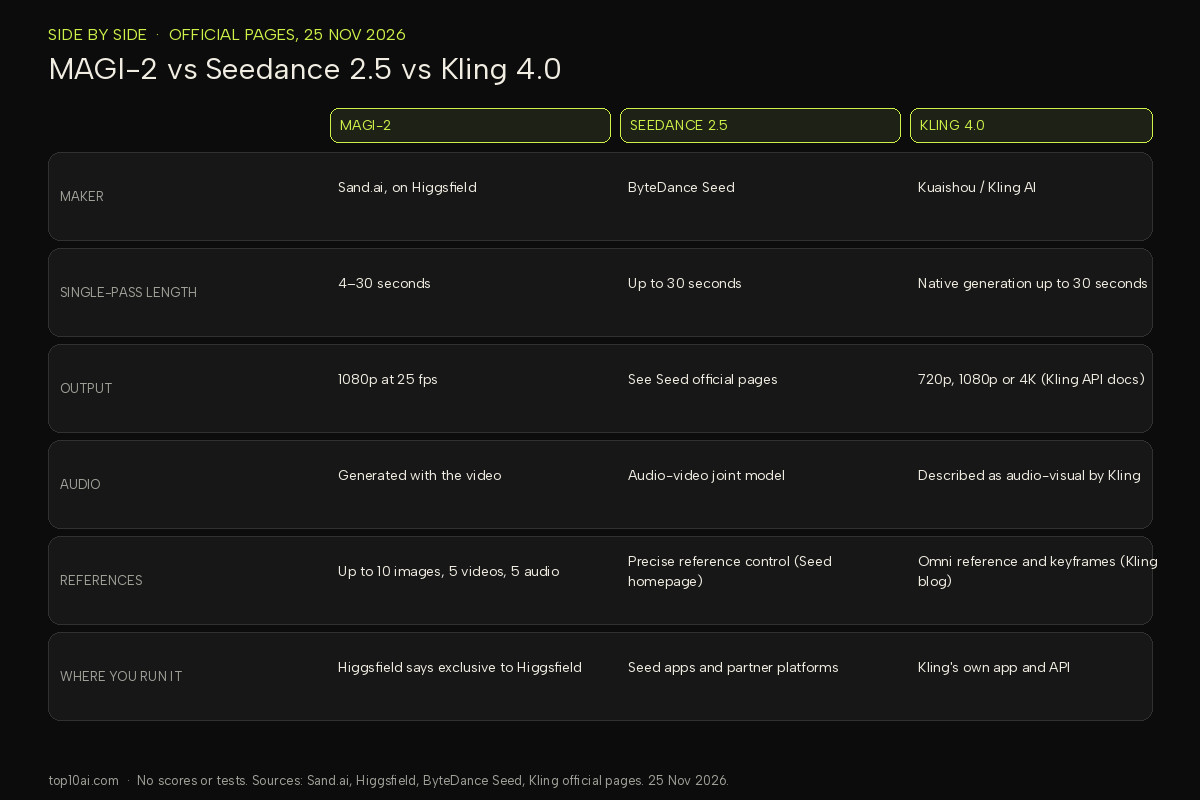
| MAGI-2 (Sand.ai, on Higgsfield) | Seedance 2.5 (ByteDance Seed) | Kling 4.0 (Kuaishou / Kling AI) | |
|---|---|---|---|
| What official pages call it | Flagship audio-video generation model, 480B total / ~28B active on Sand.ai’s blog and Higgsfield’s product page | Next-generation audio-video joint generation model (Seed homepage) | Kling’s 4.0 announcement describes a native multimodal video model with visual realism, creative control and storytelling updates |
| Single-pass length | 4 to 30 seconds (Higgsfield FAQ and API) | Up to 30 seconds in a single generation, with the option to extend twice (Seed homepage) | Native generation of up to 30 seconds (Kling 4.0 announcement). The 4.0 API lists integer durations from 3 to 30 seconds |
| Output format | 1080p at 25 fps; six aspect ratios. The Higgsfield API lists 1080p as the only resolution option | The Seed homepage describes 30-second storytelling and editing tools; it does not, in the text checked on 25 Nov 2026, headline a single output resolution | Kling’s 4.0 API lists 720p, 1080p or 4K, plus an HDR option when resolution is 1080p or 4K. The 30 Sep 2026 announcement described 10-bit HDR at 4K and 1080p as coming soon |
| Audio | Generated with the video (dialogue, sound effects, ambient sound, music). Sound can be turned off | Audio-video joint generation model (Seed homepage) | The 4.0 announcement frames Kling 4.0 around audio-visual performance and narrative completeness |
| References | Up to 10 images, 5 videos and 5 audio clips, plus optional start and end frames | Precise reference control, including reference video, per the Seed homepage | The 4.0 announcement lists omni reference and multiple keyframes |
| Editing and camera control | Prompt-directed framing, camera movement, timing and cuts; targeted edits to existing footage (Higgsfield FAQ, Sand.ai blog) | The Seed homepage lists editing capabilities, including white-model control and green-screen editing, plus professional camera movement | The 4.0 announcement lists creative control and storytelling features; see Kling’s current product pages for the live editing toolset |
| Where official pages say you can run it | Higgsfield says “available now, only on Higgsfield,” including the Higgsfield API | Seed’s own products, with partner listings covered in our Seedance 2.5 explainer | Kling’s own app and API at klingai.com / kling.ai |
| Published price snapshot (25 Nov 2026) | Higgsfield announcement: 2.5 credits/sec in the app. Higgsfield API: $0.08/sec (default 5-second request $0.40) | See official Seed / partner pricing pages; this table does not restate a Seedance per-second rate | See Kling’s official video pricing table; consumer membership prices are on Kling’s plan page |
Higgsfield also publishes its own Video Arena leaderboard. On the snapshot dated 24 Nov 2026, 16:00 UTC, Higgsfield lists MAGI-2 second of six models, with a score of 1146 and a 60.5% overall win rate, behind Seedance 2.5 (score 1219) and ahead of Seedance 2.0, Wan 3.0, Kling 4.0 and MiniMax H3. Those numbers come from Higgsfield’s announcement and the MAGI-2 product page. They are Higgsfield’s published, named-voter, head-to-head results, not a Top10AI test, and they can move as more votes come in.
Separately, Sand.ai’s 24 November blog reports a 4-task average Elo of 1150.3 for MAGI-2 on Artificial Analysis Video Arena v2.1, which it compares with 998.5 for MAGI-2 Preview (a +151.8 change). That is Sand.ai’s reported figure on its own blog, not a Top10AI measurement.
Who should use which
This section is a reading of official feature lists, not a recommendation based on clips we generated.
- MAGI-2 on Higgsfield if you specifically want Sand.ai’s November 2026 flagship: up to 30 seconds of native 1080p with sound, omni-reference (images, video and audio), start and end frames, and prompt-directed shot control, on the platform that currently hosts it. Start here:
- Seedance 2.5 if you already work in ByteDance Seed’s own products, or you want Seedance’s 30-second audio-video model and the option, stated on the Seed homepage, to extend a clip twice. Our Seedance 2.5 explainer covers where official pages said you could run it as of 24 Nov 2026.
- Kling 4.0 if you want to work in Kling’s own app or API, including the 720p / 1080p / 4K output options listed in Kling’s current API docs. Try Kling through the partner link below.
- InVideo if you want a script-to-video or editor-style workflow rather than a raw model playground. This article does not claim that InVideo hosts MAGI-2.
FAQ
What is MAGI-2?
MAGI-2 is Sand.ai’s flagship AI video model, announced on 24 November 2026. Official pages say it generates up to 30 seconds of 1080p video at 25 fps with synchronized audio, from a text prompt plus optional image, video or audio references, or start and end frames.
Who made MAGI-2, and where can I use it?
Sand.ai built the model. Higgsfield’s product page says it is available now, only on Higgsfield, including the Higgsfield API. This article does not treat other hosts as confirmed.
How long can a MAGI-2 video be, and at what resolution?
Official Higgsfield pages say 4 to 30 seconds, 1080p, 25 frames per second, in six aspect ratios. The Higgsfield API lists 1080p as the only resolution option.
How much does MAGI-2 cost?
As of 25 Nov 2026, Higgsfield’s announcement lists 2.5 credits per second in the Higgsfield app, and Higgsfield’s API reference lists USD 0.08 per second (USD 0.40 for the default 5-second video, audio included). At that API rate, a 30-second request would be $2.40. Confirm live prices before you budget, and do not assume the Free plan (0 credits on the pricing page) will run MAGI-2 for free.
Is MAGI-2 open source? Are the weights available?
Not as of 25 Nov 2026. Sand.ai says it will open-source MAGI-2 and publish a technical report. Higgsfield says open weights are coming soon. No date or license is named on those official pages, so it is not accurate to call the flagship model open source today.
Can I guide MAGI-2 with images, video or audio?
Yes, according to official pages. A single generation can take up to 10 images, 5 videos and 5 audio clips, and you can set a start frame and an end frame.
How does MAGI-2 compare with Seedance 2.5 and Kling?
All three are officially described as models that can generate around 30 seconds of video with audio. MAGI-2 is currently hosted on Higgsfield and publishes a 1080p / 25 fps output. Seedance 2.5, per ByteDance Seed, can also generate 30 seconds in one pass and offers an option to extend twice. Kling 4.0’s API lists 720p, 1080p and 4K. This is a spec comparison only; Top10AI did not rank them by quality.
Did Top10AI test MAGI-2?
No. This article is an explainer based on official vendor pages checked on 25 Nov 2026. There is no Tested badge, and we did not generate sample clips for this guide.
Related reading
- Higgsfield AI review
- Seedance 2.5: what’s new, how to try it, and the alternatives
- Best AI video generator
Sources
All sources checked 25 Nov 2026 (Asia/Nicosia). Features and prices can change; confirm them on the live vendor page. A claim-by-claim list is in SOURCES.md in this draft folder.
- Sand.ai: MAGI-2, a 480B frontier video generation model (24 Nov 2026)
- Sand.ai homepage
- Sand.ai: MAGI-2 Preview (5 Aug 2026)
- Sand AI Platform: model and pricing
- Higgsfield: MAGI-2 premieres on Higgsfield
- Higgsfield: Announcing MAGI-2
- Higgsfield US pricing page (updated 25 Nov 2026)
- Higgsfield API: MAGI-2 text-to-video
- Higgsfield API: MAGI-2 image-to-video
- Higgsfield API: MAGI-2 reference-to-video
- ByteDance Seed: Seedance 2.5 model page
- Kling: Introducing Kling 4.0 (30 Sep 2026)
- Kling API: 4.0 text-to-video
- Kling API: video pricing table
Find the Right AI Tool for You
Not sure which tool fits your workflow? Take our 30-second finder quiz and get a recommendation.