OpenAI released GPT-6.2 Astra and GPT-6.2 Sol on 17 November 2026. Astra is the new frontier model for hard projects; Sol is the efficient model for everyday work. OpenAI says both reach better results with fewer output tokens.
We ran both new models, plus GPT-6 Astra and GPT-6.1 Sol, through the same three tasks in Codex CLI on a Mac Mini. Each cell is a single run, so the timings are indicative only. We did not measure cost. Official prices, availability and benchmark figures come from OpenAI’s pages, checked the same day, and are labelled as OpenAI’s claims where they are not our results.
Quick answer
- What’s new: both models are in ChatGPT Work and Codex for Plus, Pro, Enterprise and Edu (Enterprise and Edu need a workspace admin). API ids:
gpt-6.2-astraandgpt-6.2-sol. The announcement does not mention the Free plan. - API prices, per million tokens: Astra $8 / $0.40 cached / $40, which OpenAI says is 20% below GPT-6 Astra and 60% off cached input. Sol $2 / $0.10 cached / $10, unchanged from GPT-6.1 Sol.
- Our verdict: switch everyday work to GPT-6.2 Sol. Keep GPT-6.2 Astra for hard multi-file or long agent work. The new models were about 40% faster on a landing-page build; all four passed a bug-fix test at 4/4. One run each, no cost measured, so timings are a first look, not a ranking.
What OpenAI released
See OpenAI’s 17 November 2026 announcement, Introducing GPT-6.2 Astra and Sol. The same day’s news page also lists a system card and an Astra for Law note, which we do not cover here.
From that day, OpenAI says Plus, Pro, Enterprise and Edu users get both models in ChatGPT Work and Codex. Enterprise and Edu access needs a workspace admin. Pro 500 can use Ultrafast with either model. For the first time, Pro 200 also gets Ultrafast, starting with Sol only. The API offers both model ids, with Ultrafast for both at launch.
The Codex changelog for the same date recommends Astra for the hardest projects, such as implementing and testing a change across an existing codebase, and Sol for everyday coding, writing and multistep workflows. It also says Sol lets you complete more tasks on the same paid plan than GPT-6.1 Sol.
Astra vs Sol at a glance
Figures in this table come from OpenAI’s announcement and the models page, both checked 17 November 2026. Prices are standard API rates per million tokens, in US dollars, not ChatGPT subscription prices.
| GPT-6.2 Astra | GPT-6.2 Sol | |
|---|---|---|
| Role | Frontier model for the hardest projects | Everyday work: coding, writing, agents |
| API id | gpt-6.2-astra |
gpt-6.2-sol |
| API price | $8 in / $40 out | $2 in / $10 out |
| Cached input | $0.40 | $0.10 |
| Context window | 1.05 million tokens | 1.05 million tokens |
| Max output | 128,000 tokens | 128,000 tokens |
| Knowledge cutoff | 18 May 2026 | 1 June 2026 |
| Reasoning effort | low, medium, high, xhigh, max | low, medium, high, xhigh, max |
| Tools | Functions, web search, file search, computer use | Functions, web search, file search, computer use |
What’s changed versus GPT-6 Astra and GPT-6.1 Sol
Astra’s input and output prices are 20% below GPT-6 Astra, with a 60% discount on cached input. Sol keeps GPT-6.1 Sol’s $2 / $0.10 / $10 rates. OpenAI also says both new models deliver better results with fewer output tokens.
These figures are OpenAI’s own benchmark claims, not tests we ran:
- Agents’ Last Exam: Astra +5.2 points vs GPT-6 Astra at under one-third the cost, and +5.5 vs Claude Fable 5.2 at 5% of the cost.
- Terminal-Bench-Science 0.1: Astra +9 points vs GPT-6 Astra at under one-third the cost; also a new high on the Vals Science Index.
- GDPval v2 (OpenAI internal): Astra +6.2 points vs GPT-6 Astra with 22% fewer output tokens; Sol +5.3 vs GPT-6.1 Sol.
- FrontierCode 2.0 (Cognition): Sol within 0.5 points of Astra at about one-fifth the cost, both at max.
- LifeVal: Sol outscores GPT-6 Astra at about one-seventh the cost.
- AA-AnalystAgent: Astra 62.5%, all five attempts correct. AA-3D Elo: Astra 1,318, Claude Fable 5.2 1,271, Sol 1,259.
- Harvey LAB-AA v1.1: Astra more than doubles Fable 5.2’s pass rate at about one-sixth the cost.
We have not reproduced those evaluations.
Our hands-on tests
We ran the tests on 17 November 2026, starting at 20:00 Asia/Nicosia (UTC+2), on a Mac Mini. Codex CLI 0.162.1 rejected both new models (“not supported when using Codex with a ChatGPT account”). After codex update to 0.169.0, all four models were selectable under the same ChatGPT sign-in.
Each run used codex exec --skip-git-repo-check -s workspace-write -m <model> -c model_reasoning_effort=medium, with a 600-second cap. The four models ran in parallel; tasks ran in sequence. We recorded wall-clock time. n = 1 per cell, so timings are indicative only. Codex “tokens used” includes the system prompt and tool turns; it is not a cost figure, and we did not measure spend.
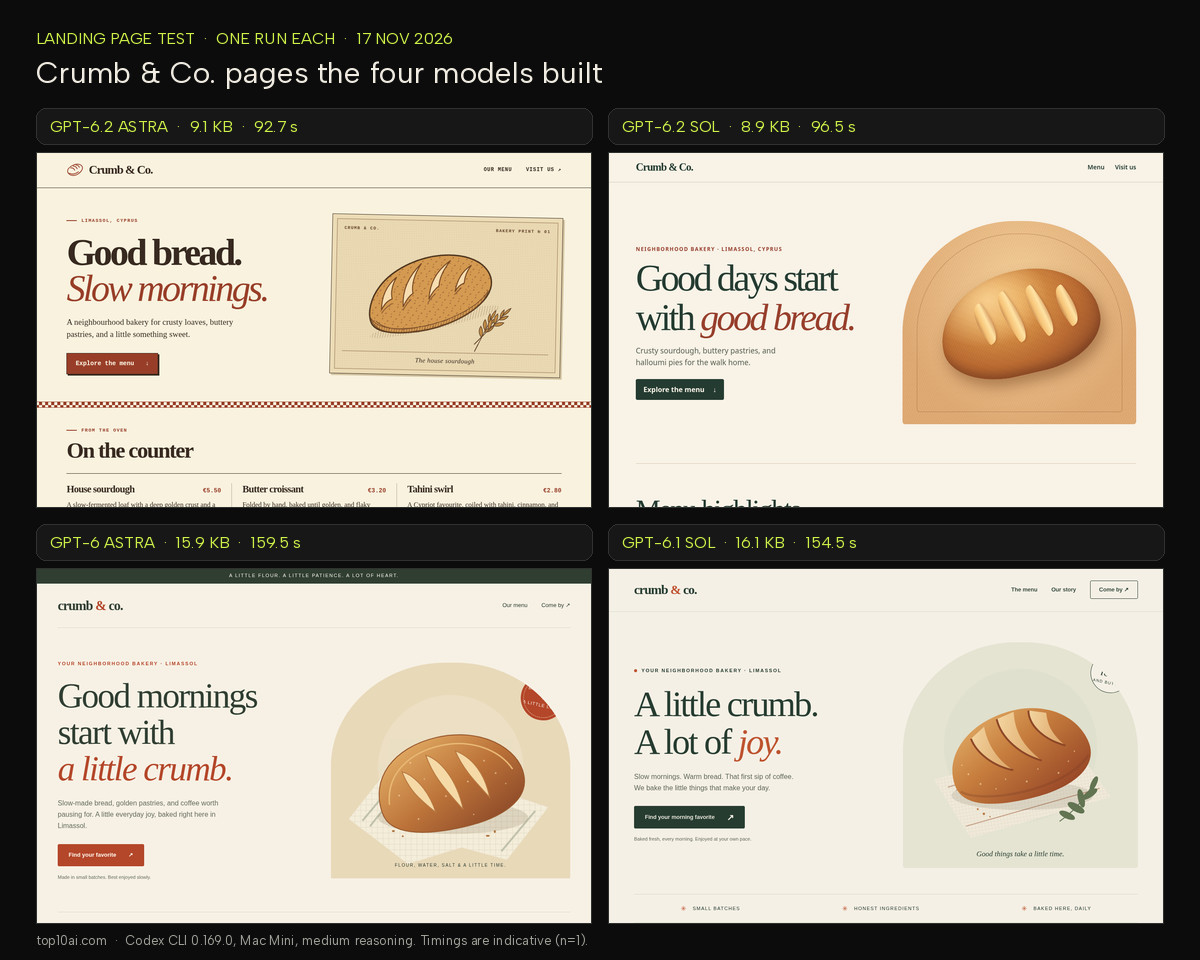
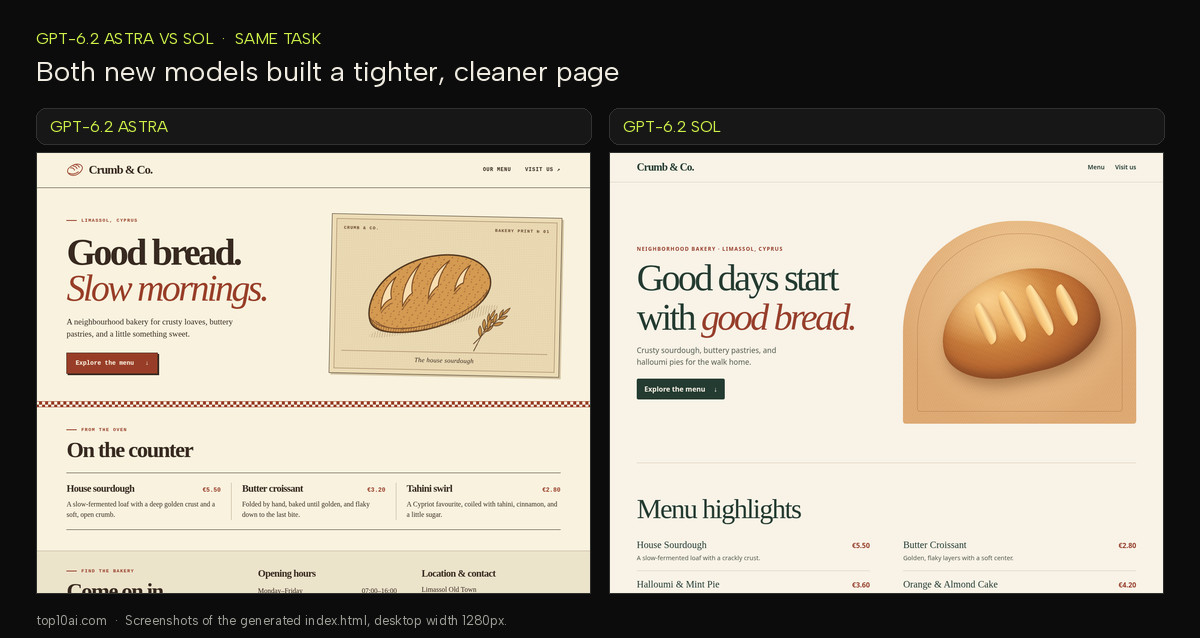
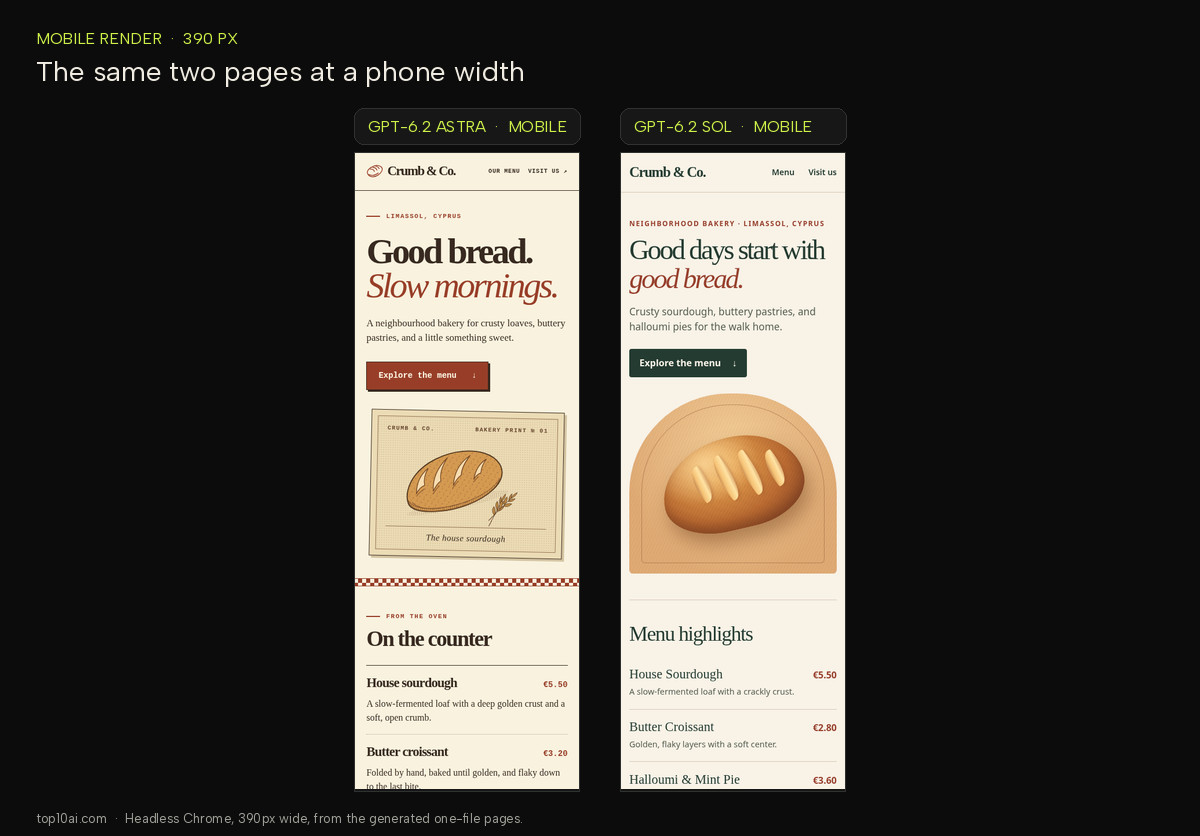
The tasks were: (a) a one-file landing page for a fictional Limassol bakery, Crumb & Co., with inline CSS and euro prices; (b) fix a Python script that totals sales by region (it dropped the first data row and used int() on decimal amounts) and add --top N, checked with four hidden tests including an unseen CSV; (c) a 150-word comparison of Cursor and Lovable, no headings.
| Task | GPT-6.2 Astra | GPT-6.2 Sol | GPT-6 Astra | GPT-6.1 Sol |
|---|---|---|---|---|
| Landing page | 92.7 s, 29,394 tokens, 9.1 KB | 96.5 s, 30,297 tokens, 8.9 KB | 159.5 s, 19,909 tokens, 15.9 KB | 154.5 s, 32,836 tokens, 16.1 KB |
Fix script + --top N |
44.8 s, 23,296 tokens, 4/4 | 55.3 s, 16,737 tokens, 4/4 | 49.1 s, 5,746 tokens, 4/4 | 47.2 s, 15,389 tokens, 4/4 |
| 150-word comparison | 36.6 s, 27,870 tokens, 150 words | 40.2 s, 24,394 tokens, 151 words | 41.0 s, 21,294 tokens, 149 words | 46.7 s, 38,218 tokens, 152 words |
On the landing page, the new models finished about 40% faster (Astra about 42% faster than GPT-6 Astra; Sol about 38% faster than GPT-6.1 Sol). The older models wrote larger, more decorated pages (15.9–16.1 KB). The new ones were tighter: Astra 9.1 KB with three menu items and no external assets; Sol 8.9 KB with four menu items and one Google Maps link. GPT-6 Astra used fewer Codex-reported tokens here (19,909 versus about 29,000–30,000) while taking longer; we are not treating token counts as cost.
On the bug-fix task, all four models repaired both seed bugs, added --top N and passed every hidden test, including the unseen CSV. Times were 44.8 to 55.3 seconds, a wash. The seed script scored 0/4 before the edits.
On the writing task, all four hit the word-count window and described Cursor and Lovable accurately. We did not spot an obvious factual error. GPT-6.2 Astra was the most concrete. GPT-6 Astra added three markdown links we had not asked for; those links returned HTTP 200.
Which one should you use?
- Solo builders and everyday Codex work: start with GPT-6.2 Sol. Same API price as GPT-6.1 Sol, and faster on our landing-page test.
- Multi-file refactors or long agent runs: keep GPT-6.2 Astra for the hard jobs, as the Codex changelog recommends. The lower per-token price versus GPT-6 Astra helps if those runs are long. Our short tasks did not separate the two new models on quality.
- Budget API workloads: Sol is cheaper at $2 / $10. The 17 November 2026 API changelog also adds a Responses API background window, 30% off for two hours and 40% off for eight hours. We have not used that window in these tests.
See also our notes on GPT-6 Astra, Codex versus Claude Code, and the AI coding tools list. Those pages were not updated in this pass.
How to get it in Codex, and a note on the API
Update the Codex CLI first: codex update (we landed on 0.169.0). Then select a model with -m gpt-6.2-sol or -m gpt-6.2-astra. The same ids are what the API expects.
OpenAI’s API changelog for 17 November 2026 says both models work with the Responses API and Chat Completions, but tool calling requires the Responses API. If your app still calls tools through Chat Completions, plan that migration before you switch production traffic.
Safety and limitations
OpenAI rates both models Critical for cybersecurity and High for biological and chemical capabilities under its Preparedness Framework, and is launching them with tighter cybersecurity safeguards that, it says, also restrict some legitimate vulnerability research. GPT-6.2 Astra is its first externally released model rated High for AI self-improvement. OpenAI also says both models were more likely than GPT-6 Astra to omit mentioning blockers such as a missing file, and that it added mitigations in Codex. We did not run a safety evaluation. Our own limits: one run per cell, three short tasks, medium reasoning, no cost measured, and token totals that include Codex overhead.
FAQ
Is GPT-6.2 Sol better than GPT-6 Astra?
OpenAI says Sol beats GPT-6 Astra on LifeVal at about one-seventh the cost (OpenAI’s claim). In our tests the results were similar, and Sol was faster on the landing page.
How much does GPT-6.2 Astra cost in the API?
OpenAI lists $8 per million input tokens, $0.40 cached and $40 output, 20% below GPT-6 Astra and 60% off cached input.
What is the GPT-6.2 context window?
OpenAI lists 1.05 million context tokens and 128,000 max output for both models. Cutoffs are 18 May 2026 for Astra and 1 June 2026 for Sol.
Is GPT-6.2 available on ChatGPT Plus or on the Free plan?
The announcement names Plus, Pro, Enterprise and Edu. It does not mention the Free plan, so we do not assume Free is included.
Why does Codex say the model is not supported?
Update the Codex CLI. Version 0.162.1 rejected the new models; 0.169.0 worked in our test (codex update).
What is Ultrafast, and who gets it?
Pro 500 gets Ultrafast for both models. Pro 200 gets it for the first time, for Sol only. The API offers it for both at launch.
Does GPT-6.2 support tool calling in Chat Completions?
Tool calling requires the Responses API, per OpenAI’s 17 Nov 2026 API changelog.
Astra vs Sol for coding: which should I use?
Sol for everyday coding and writing; Astra for a hard change across an existing repo or a long agent run.
Related reading
Sources
- OpenAI, Introducing GPT-6.2 Astra and Sol, 17 November 2026.
- OpenAI News (announcement, system card and Astra for Law listings), checked 17 November 2026.
- ChatGPT & Codex changelog, 17 November 2026 entry and the 13 November 2026 Codex CLI 0.169.0 entry.
- OpenAI API models page, checked 17 November 2026.
- OpenAI API changelog, 17 November 2026 entries.
Find the Right AI Tool for You
Not sure which tool fits your workflow? Take our 30-second finder quiz and get a recommendation.